Which One Should You Actually Take? A Clinically Honest Comparison — With Dosing, Timing, and the Case for Taking Both
| 📎 Affiliate Disclosure |
| This article contains affiliate links. Supplement links go to Amazon (affiliate ID: smg00ab-20). If you purchase through a link, ResetMindHub.com earns a small commission at no extra cost to you. As an Amazon Associate, ResetMindHub.com earns from qualifying purchases. Supplement recommendations are based on clinical research, extract quality, third-party testing, and evidence base — not commission rates. This article does not constitute medical advice. Always consult your healthcare provider before starting any supplement. |
| These two supplements are often lumped together as ‘natural anxiety remedies’ — but they work through completely different mechanisms on different timescales. Choosing the wrong one for your situation won’t harm you, but it will disappoint you. This guide tells you exactly which one you need. |
You’ve seen both names on every wellness shelf and in every supplement roundup. L-theanine. Ashwagandha. Both are marketed for stress and anxiety. Both are backed by real clinical research. And both are almost always compared as if the question is ‘which is better’ — when the real question is ‘which is better for what, and when?’
The answer is not the same for everyone. L-theanine is an amino acid that works in your brain within the hour, promoting calm alertness without sedation. Ashwagandha is an adaptogenic herb that works on your hormonal stress system over weeks, building resilience from the roots up. They are different tools for different problems — and for many people, the best answer is a thoughtful combination of both.
This guide cuts through the supplement marketing noise with clinical precision: what each compound actually does, what the research says about each, who each suits, how to dose them, what to buy, and how to use them together safely.
Head-to-Head: The Core Differences at a Glance
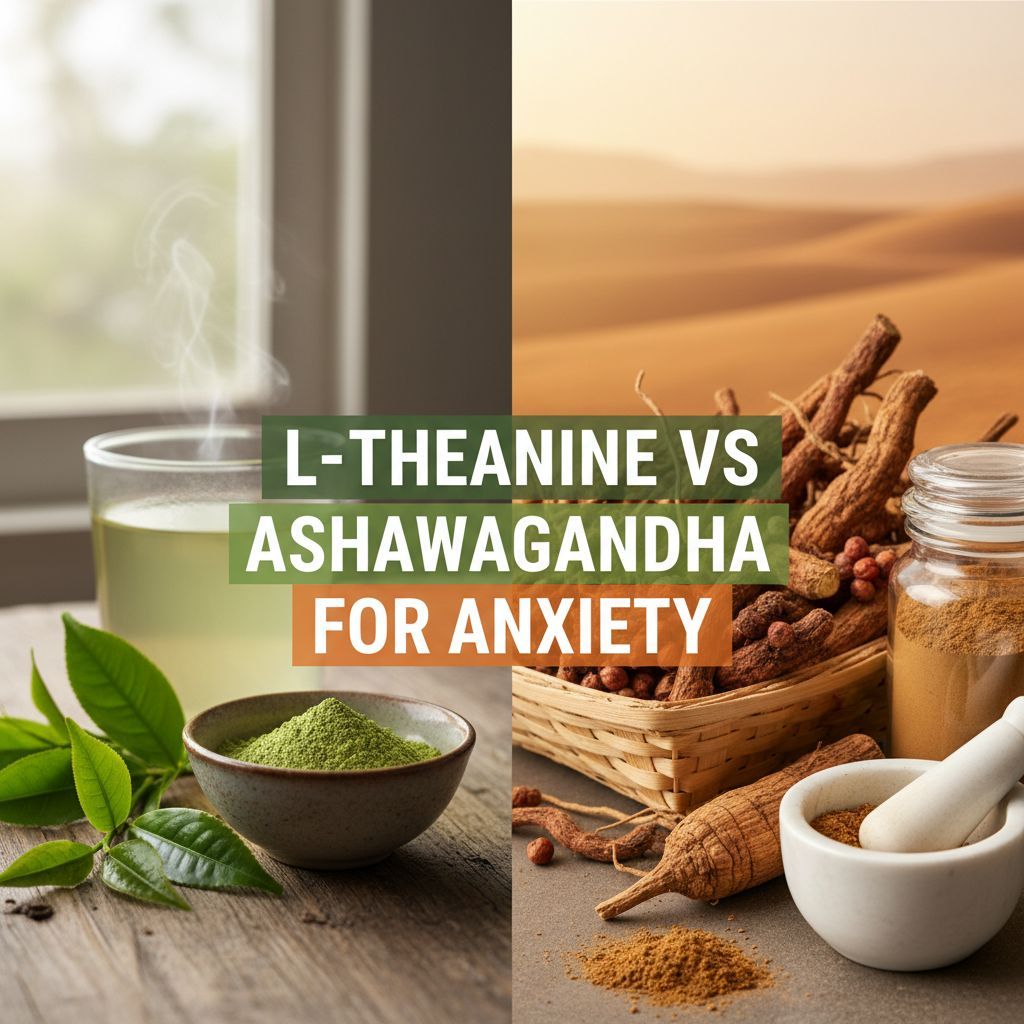
| 🍵 L-Theanine Calm Alertness — Fast | VS | 🌿 Ashwagandha Stress Resilience — Long-Term |
| Amino acid from green tea | What it is | Adaptogenic herb (Withania somnifera) |
| Increases alpha brain waves, boosts GABA | How it works | Regulates HPA axis, lowers cortisol |
| 30–60 minutes | Onset time | 4–8 weeks of daily use |
| 100–200mg (up to 400mg studied) | Dose range | 300–600mg KSM-66 extract |
| Acute anxiety, focus, jitters from caffeine | Best for | Chronic stress, burnout, poor sleep |
| Morning or before stressful events | When to take | Evening or twice daily (consistent timing) |
| Excellent — no known serious interactions | Safety profile | Good; avoid with thyroid meds, in pregnancy |
| Weeks to months (daytime tool) | Duration of use | 8–12 weeks minimum; may cycle |
| No — promotes alertness | Causes drowsiness? | Mild sedation possible at higher doses |
🍵 L-Theanine: The Science of Calm Alertness
What It Is
L-theanine is an amino acid found almost exclusively in green tea leaves (Camellia sinensis) and, to a lesser extent, in certain mushrooms. It was first isolated from tea in 1949 and has since become one of the most studied naturally occurring compounds for anxiety and cognitive performance. Each cup of green tea contains approximately 6.5mg of L-theanine per gram of tea leaf — meaning you’d need 8+ cups to approach a therapeutic dose, which is why supplementation makes practical sense.
How It Works
L-theanine crosses the blood-brain barrier rapidly and influences several key neurotransmitter systems. It enhances GABA activity (the brain’s main calming signal), increases alpha brain wave activity — the brain state associated with relaxed alertness, creativity, and being ‘in the zone’ — and modulates glutamate, the brain’s main excitatory neurotransmitter.
The result is a state researchers describe as ‘relaxed alertness’: calm without sedation, focused without stimulation. It is the same neurological state associated with meditation. This is also why green tea, despite containing caffeine, produces a qualitatively different experience than coffee — the L-theanine modulates the caffeine’s stimulating effects.
Stress feels different for everyone. What's your type?
Take the free 2-minute Stress Reset Assessment and find out.
Take the Free Stress Test →What the Research Shows
A landmark 2019 randomised controlled trial published in Nutrients found that L-theanine supplementation significantly improved sleep satisfaction and reduced stress-related symptoms in adults experiencing moderate anxiety. A 2024 study in the Journal of Psychopharmacology showed that 100–200mg daily reduced anxiety symptoms within an hour and boosted alpha brain waves for calm focus. A 2025 PubMed review confirmed that 200mg lowered stress without sedation in most users.
A review of five studies involving over 100 participants found that L-theanine significantly reduced stress and anxiety, especially during challenging moments. A 2012 randomised trial demonstrated that L-theanine effectively reduced heart rate and cortisol responses during stressful tasks, confirming its rapid anxiolytic properties.
The L-theanine + caffeine combination (100–200mg each) is one of the most well-studied nootropic stacks, consistently shown to produce alert focus without the jittery side effects of caffeine alone. It smooths the energy curve while preserving cognitive benefits.
Dosing Guide
- General anxiety and focus: 100–200mg as needed or daily
- Acute situational anxiety (presentation, difficult conversation): 200mg taken 30–60 minutes before
- With caffeine (coffee or pre-workout): 100–200mg, same time as caffeine
- Maximum studied dose: 400mg; higher doses show diminishing returns
- No loading phase required — effects felt within 30–60 minutes of first dose
Safety Profile
L-theanine has an exceptional safety record. It is generally recognised as safe (GRAS) by the FDA. No serious adverse effects have been documented in clinical trials at doses up to 400mg. It does not cause dependence, tolerance, or withdrawal. It has no known clinically significant drug interactions. It is safe for daily long-term use. It is one of the safest anxiety-support supplements available.
| L-theanine is the right tool when you need calm alertness now — before a meeting, during a stressful morning, or alongside coffee that’s making you anxious. It works within the hour and wears off gradually without a crash. |
🌿 Ashwagandha: The Science of Stress Resilience
What It Is
Ashwagandha (Withania somnifera) is a root and leaf extract from a plant native to India, the Middle East, and parts of Africa. It has been a cornerstone of Ayurvedic medicine for over 3,000 years and is classified as an adaptogen — a substance that helps the body adapt to and recover from chronic stress, primarily by modulating the hormonal stress response rather than producing immediate neurological changes.
The most clinically studied form is KSM-66, a patented, full-spectrum root-only extract standardised to contain a minimum of 5% withanolides (the bioactive compounds responsible for its stress-reducing effects). Generic ashwagandha powders typically contain only 0.5–2% withanolides, making KSM-66 significantly more potent and reliable for clinical outcomes.
How It Works
Ashwagandha works primarily by modulating the hypothalamic-pituitary-adrenal (HPA) axis — the body’s central stress response system. In chronic stress, the HPA axis becomes dysregulated: cortisol production stays elevated, disrupting sleep, mood, focus, immune function, and metabolic health. Ashwagandha’s withanolides help restore healthy cortisol rhythms — high in the morning, low at night — gradually rebuilding the resilience of a system that has been running too hot for too long.
At the brain chemistry level, ashwagandha is often described as ‘GABA-like’ — it supports the same calming signal as GABA by reducing the stress drive upstream rather than directly modulating brain wave activity. The result is a gradual reduction in baseline anxiety, improved sleep, and a diminished stress response to triggers that previously overwhelmed the system.
What the Research Shows
A landmark double-blind, placebo-controlled trial (Chandrasekhar et al., 2012) involving 64 chronically stressed adults found that 300mg of ashwagandha root extract taken twice daily for 60 days produced significant reductions in anxiety symptoms on the Hamilton Anxiety Rating Scale and a 23–28% reduction in serum cortisol. A 2025 Nutrients study found 300mg twice daily reduced anxiety by 30% in stressed adults after eight weeks, with a 2.58-unit cortisol drop confirmed in a 2024 ScienceDirect meta-analysis.
A comprehensive 2020 meta-analysis published in Medicine (Baltimore) concluded that ashwagandha significantly reduced anxiety and stress across multiple clinical trials. A Cureus (2020) study showed that 8 weeks of ashwagandha supplementation improved both sleep quality and anxiety scores in adults with chronic insomnia. One study reported a nearly 50% reduction in cortisol levels after 60 days of high-concentration extract use.
Psychology Today reviewed the evidence in June 2025, noting that both ashwagandha’s stress-reducing and cortisol-lowering effects are meaningful for people with chronic, entrenched stress — not just ‘bad days’ — distinguishing it clearly from faster-acting, symptom-focused supplements.
Dosing Guide
- Standard clinical dose: 300–600mg of KSM-66 extract daily
- For sleep and cortisol: take in the evening, 1–2 hours before bed
- For general chronic stress: twice daily (morning and evening) at 300mg each
- Minimum effective duration: 4–8 weeks; full benefits typically at 8–12 weeks
- Consider cycling: 8 weeks on, 2–4 weeks off (though daily use is also well tolerated)
- Always use KSM-66 or Sensoril extract — avoid generic ‘ashwagandha powder’ with unknown withanolide content
Safety Profile and Contraindications
Ashwagandha is generally safe for most healthy adults. However, there are important contraindications that set it apart from L-theanine’s near-universal safety profile:
- Pregnancy and breastfeeding: Do not use — may stimulate uterine contractions
- Thyroid disorders: May elevate thyroid hormone levels; use with caution and medical supervision
- Autoimmune conditions (lupus, rheumatoid arthritis, MS): May stimulate immune activity; avoid without medical guidance
- Thyroid medications: Potential interaction — consult your doctor
- Sedatives, immunosuppressants, diabetes medications: Potential interactions — consult your doctor
- Rare reports of liver enzyme elevation at high doses — use clinical doses (300–600mg) not megadoses
- Mild sedation possible at higher doses (≥600mg) — avoid driving if this occurs
| Ashwagandha is the right tool when you need to address the root cause of chronic stress over weeks — restoring cortisol rhythms, improving sleep quality, and rebuilding stress resilience. It won’t help your presentation nerves in an hour. But eight weeks from now, those nerves may be significantly quieter. |
Can You Take L-Theanine and Ashwagandha Together?
Yes — and for many people, this combination is the most effective approach. They work through different mechanisms on different timescales and do not negatively interact with each other.
L-theanine provides immediate, daytime calm alertness. Ashwagandha builds long-term systemic stress resilience. Used together, they address both the symptoms (acute anxiety) and the cause (dysregulated stress physiology). Many commercial supplements already combine both: Nature’s Truth KSM-66 Ashwagandha with L-Theanine (600mg KSM-66 + 200mg L-theanine per serving) and Nature’s Bounty Stress Relief (600mg KSM-66 + 200mg L-theanine) are among the most popular combination products on Amazon.
The standard combination approach recommended across clinical literature:
| Time of day | Supplement | Dose | Purpose |
| Morning (with coffee) | L-Theanine | 100–200mg | Smooth caffeine energy, calm focus, reduce jitters |
| Before stressful event | L-Theanine | 200mg (30–60 min before) | Acute anxiety reduction, presentation calm |
| Afternoon (if needed) | L-Theanine | 100mg optional | Sustained calm without afternoon slump |
| Evening (2 hrs before bed) | Ashwagandha | 300–600mg KSM-66 | Cortisol reduction, sleep quality, HPA regulation |
| With evening ashwagandha | L-Theanine | 100–200mg | Enhanced relaxation (optional combination) |
| Start with one supplement first. If you’ve never used either, begin with L-theanine for two weeks to understand your response before adding ashwagandha. This helps you attribute any effects or side effects accurately. |
Which One Should You Take? Your Personalised Decision Guide
| Your situation | Recommended choice |
| I need to calm down for a meeting or presentation in the next hour | L-Theanine 200mg, 30–60 mins before |
| I drink coffee but get jittery or anxious from it | L-Theanine 100–200mg with your coffee |
| I want to focus without feeling drowsy or sedated | L-Theanine (morning or mid-morning) |
| I’ve been burnt out or chronically stressed for weeks or months | Ashwagandha KSM-66 300–600mg daily |
| I wake up wired at night and exhausted in the morning | Ashwagandha (evening, restores cortisol rhythm) |
| I want to improve sleep quality over time | Ashwagandha (or ashwagandha + L-theanine at night) |
| I have generalised anxiety as an ongoing condition | Ashwagandha daily (4–8 weeks) + consider therapy |
| I’m managing burnout and want immediate + long-term support | Both: L-theanine daytime, ashwagandha evening |
| I’m new to supplements and want the safest starting point | L-Theanine — exceptional safety, fast feedback |
| I take thyroid medication or have an autoimmune condition | L-Theanine only — consult your doctor before ashwagandha |
Best L-Theanine Supplements to Buy in 2026
Look for products containing Suntheanine® — the patented, pharmaceutical-grade L-theanine used in most clinical research. Third-party testing for purity is the second most important criterion.
| 🍵 Pure Encapsulations L-Theanine Best Overall — Clinical Grade, Third-Party Tested | |
| Pure Encapsulations is the gold standard in clinical-grade supplements, used by integrative physicians and recommended across functional medicine practices. Their L-theanine uses Suntheanine® and is third-party tested for purity, potency, and the absence of common allergens. Suntheanine® — the clinically studied, patented form used in researchThird-party tested by independent lab for purity and potencyFree from gluten, dairy, soy, GMOs, and artificial additives200mg per capsule — the most commonly studied effective doseHypoallergenic formula — suitable for sensitive individualsTrusted by integrative medicine practitioners | Dose per serving 200mg Suntheanine® per capsule Certifications Third-party tested, GMP certified, hypoallergenic Price range $25–$40 (60 capsules) Amazon link [INSERT Amazon link — tag=smg00ab-20] |
| ℹ️ ResetMindHub Take: The most trusted clinical-grade L-theanine available. If you want the form used in research with maximum purity assurance, this is the one. | |
| 💪 NOW Foods L-Theanine 200mg Best Value — Reliable Brand at an Affordable Price | |
| NOW Foods has been a trusted supplement manufacturer since 1968 with consistent quality standards and independent testing. Their L-theanine delivers an effective 200mg dose at a significantly lower price than premium brands, making it the strongest value pick for daily use. 200mg L-theanine per capsule — effective dose in one tabletNOW ASSURED™ quality programme with in-house testingVegan and vegetarian friendlyNon-GMO and free from major allergensOne of the most reviewed L-theanine supplements on AmazonAvailable in bulk sizes for regular daily users | Dose per serving 200mg per capsule Certifications In-house tested, GMP certified, non-GMO Price range $14–$22 (120 capsules) Amazon link [INSERT Amazon link — tag=smg00ab-20] |
| ℹ️ ResetMindHub Take: The best budget L-theanine that doesn’t compromise on quality. For daily maintenance use, NOW Foods delivers reliable results at a fraction of premium prices. | |
Best Ashwagandha Supplements to Buy in 2026
Always buy KSM-66 or Sensoril extract standardised to 5%+ withanolides. Avoid generic ‘ashwagandha root powder’ products with no extract standardisation — their withanolide content is too low and variable for clinical effectiveness.
| 🌿 Transparent Labs KSM-66 Ashwagandha Best Overall — Clinically Validated Dose, Transparent Labelling | |
| Transparent Labs is consistently rated the top ashwagandha supplement by Fortune, Healthline, and independent reviewers for combining the clinically validated KSM-66 extract at a proper dose with fully transparent labelling and third-party testing. No proprietary blends, no hidden fillers — just KSM-66 at the dose research supports. KSM-66® — the most clinically studied ashwagandha extract (600mg per serving)Standardised to ≥5% withanolides — the bioactive compounds driving research outcomesThird-party tested by Informed Sport for purity, potency, and banned substancesNo artificial additives, fillers, or proprietary blendsRated best overall by Fortune and multiple independent review outlets in 2026Suitable for vegans; gluten-free and non-GMO certified | Dose per serving 600mg KSM-66® per serving Certifications Informed Sport certified, third-party tested, GMP Price range $25–$40 (60 servings) Amazon link [INSERT Amazon link — tag=smg00ab-20] |
| ℹ️ ResetMindHub Take: The most trustworthy ashwagandha supplement on the market in 2026. The combination of clinical dose, verified extract quality, and full label transparency makes it the benchmark recommendation. | |
| 🍃 Nature’s Truth KSM-66 + L-Theanine Best Combination Product — Both Supplements in One | |
| For people who want to use both supplements together, Nature’s Truth has formulated a convenient combination product delivering 600mg of KSM-66 ashwagandha and 200mg of L-theanine in two caplets. This eliminates the need to buy and manage two separate supplements and represents strong value for the combination approach. 600mg KSM-66® ashwagandha + 200mg L-theanine per serving (2 caplets)Combines both clinically studied doses in a single productVegan coated caplets — easy to swallowNon-GMO, gluten-free, soy-free, and dairy-freeStrong Amazon review base with consistently positive user feedbackBest value for those who plan to use both supplements long-term | Dose per serving 600mg KSM-66 + 200mg L-theanine Certifications Non-GMO, gluten-free, vegan Price range $18–$28 (30 servings) Amazon link [INSERT Amazon link — tag=smg00ab-20] |
| ℹ️ ResetMindHub Take: The best-value entry point for the combination approach. If you’ve decided to use both, this saves money and simplifies your routine. Start here before buying separate premium versions. | |
| 💤 Pure Encapsulations Ashwagandha (KSM-66) Best Clinical Grade Ashwagandha — For Those Who Want Maximum Purity | |
| For buyers who prioritise clinical-grade purity above all else — particularly those with sensitivities, complex health conditions, or who are supplementing under medical supervision — Pure Encapsulations delivers the most rigorously tested ashwagandha available. 4.7 stars from 3,200+ Amazon reviews. 500mg KSM-66® per capsule — one capsule daily at therapeutic doseHypoallergenic formula: gluten-free, soy-free, dairy-free, non-GMOThird-party tested; trusted by integrative and functional medicine practitioners4.7 stars from 3,200+ Amazon reviews with consistent reports of reduced anxiety and improved sleepUsed in clinical settings and recommended by healthcare providersClean label: no fillers, no coatings, no unnecessary additives | Dose per serving 500mg KSM-66® per capsule Certifications Third-party tested, GMP, hypoallergenic Price range $35–$50 (60 capsules) Amazon link [INSERT Amazon link — tag=smg00ab-20] |
| ℹ️ ResetMindHub Take: The clinical choice for people supplementing under medical supervision or who need maximum purity assurance. The 4.7-star rating from 3,200+ reviews makes it one of the most validated ashwagandha products available. | |
People Also Ask: L-Theanine vs Ashwagandha, Answered
Is L-theanine or ashwagandha better for anxiety?
Neither is universally better — they suit different types of anxiety. L-theanine is better for acute, situational anxiety: the kind that strikes before a presentation, during a stressful workday, or alongside caffeine. It works within 30–60 minutes and promotes calm without sedation. Ashwagandha is better for chronic anxiety: the kind that has been building for weeks or months, is driven by elevated cortisol, and disrupts sleep. It requires 4–8 weeks of daily use to show full benefits but addresses the physiological root cause rather than the symptoms.
Can I take L-theanine and ashwagandha together?
Yes — they are safe to combine and work synergistically. They operate through different mechanisms: L-theanine modulates brain waves and neurotransmitters for immediate calm; ashwagandha regulates the HPA axis and cortisol for long-term resilience. The recommended combination is L-theanine during the day (100–200mg with or without coffee) and ashwagandha in the evening (300–600mg KSM-66). Always start with one supplement first and introduce the second after two weeks so you can assess each one’s effects independently.
How long does L-theanine take to work?
L-theanine crosses the blood-brain barrier rapidly and begins increasing alpha brain wave activity within 30–60 minutes of ingestion. Most people notice a calming effect within that window. Unlike ashwagandha, L-theanine does not require a loading phase or cumulative effect — it works from the first dose. Its calming effect lasts approximately 3–6 hours, after which a second dose can be taken if needed.
How long does ashwagandha take to work?
Ashwagandha typically requires 4–8 weeks of consistent daily use to produce measurable anxiety and stress reduction. Some users notice modest improvements in sleep and mood within 2–4 weeks. The full cortisol-regulating and HPA axis-stabilising benefits develop over 8–12 weeks. This is why ashwagandha should be evaluated on trends over time, not on how you feel after the first dose. If you need faster relief, use L-theanine while ashwagandha builds in the background.
What is KSM-66 ashwagandha?
KSM-66 is a patented, full-spectrum ashwagandha root extract manufactured by Ixoreal Biomed. It is the most clinically studied ashwagandha extract in the world, standardised to contain a minimum of 5% withanolides — the bioactive compounds responsible for ashwagandha’s stress-reducing and cortisol-lowering effects. Generic ashwagandha root powder typically contains only 0.5–2% withanolides. When buying ashwagandha, always look for KSM-66 or Sensoril on the label to ensure you are getting clinical-grade potency.
Can L-theanine be taken daily?
Yes. L-theanine is safe for daily long-term use at doses of 100–400mg. It does not cause tolerance, dependence, or withdrawal. It has no known clinically significant drug interactions and is classified as generally recognised as safe (GRAS) by the FDA. Many people take 200mg of L-theanine daily with their morning coffee as a consistent daytime anxiety management practice.
Does ashwagandha cause drowsiness?
Mild sedation is possible at higher doses (≥600mg), particularly in people who are more sensitive to its GABA-like effects. At standard clinical doses (300–600mg KSM-66), most users do not experience significant daytime drowsiness — particularly when taking the morning dose at 300mg. The evening dose often supports sleep, which is a benefit rather than a side effect. If you experience daytime drowsiness, reduce to one 300mg dose taken exclusively in the evening.
Who should not take ashwagandha?
Ashwagandha is contraindicated for: pregnant and breastfeeding women (may stimulate uterine contractions); people with thyroid disorders or taking thyroid medications (may elevate thyroid hormone levels); people with autoimmune conditions such as lupus, rheumatoid arthritis, or multiple sclerosis (may stimulate immune activity); and people taking sedatives, immunosuppressants, or diabetes medications (potential interactions). L-theanine carries none of these contraindications and is a safer choice for anyone in these groups.
What is the best L-theanine supplement?
Look for products containing Suntheanine® — the patented, pharmaceutical-grade L-theanine used in clinical research. Pure Encapsulations L-Theanine (Suntheanine®, 200mg, third-party tested) is the top clinical-grade recommendation. For value, NOW Foods L-Theanine (200mg) is a reliable, well-reviewed option at roughly half the price. Both are available on Amazon with links in this article (tag: smg00ab-20).
Is ashwagandha or L-theanine better for sleep?
For sleep, ashwagandha is the stronger choice. Multiple studies show that ashwagandha supplementation improves sleep onset, sleep quality, and nighttime cortisol regulation over 4–8 weeks — particularly for people whose poor sleep is driven by elevated evening cortisol. L-theanine can support the pre-sleep transition (taken 30–60 minutes before bed, it promotes relaxation without sedation), making the combination — ashwagandha at 300–600mg + L-theanine at 100–200mg, both taken in the evening — the most effective approach for anxiety-related insomnia.
Final Thoughts: It’s Not Either/Or
The most common mistake people make with these supplements is treating the choice as binary. L-theanine or ashwagandha. Fast or slow. Brain or body. In reality, they are complementary tools that address different layers of the same problem.
Anxiety that arrives in the moment — before a difficult conversation, during a stressful commute, alongside a triple espresso — is best met with L-theanine. Anxiety that has been accumulating for months, disrupting sleep, spiking cortisol, and leaving you wired and exhausted simultaneously, is best addressed by ashwagandha’s systemic, gradual work on the HPA axis.
For most people reading this, the answer is: start with L-theanine today, and add KSM-66 ashwagandha in the evening over the next eight weeks. Then reassess. The research says both work. The logic says they work better together.
At ResetMindHub.com, we’ll always tell you what the science says — and what it doesn’t. Neither of these supplements is a replacement for therapy, medication, or professional care when those are what’s needed. But as part of a thoughtful, multi-layered approach to anxiety management, they are two of the most evidence-supported natural tools available.
| Always consult your healthcare provider before starting any supplement, particularly if you take medications, have a pre-existing condition, or are pregnant or breastfeeding. Supplements interact with bodies differently — individual results vary. |
🚨 When Supplements Aren’t Enough
Supplements can support anxiety management — they cannot treat an anxiety disorder. If your anxiety is significantly affecting your daily life, relationships, or work, please speak to a licensed mental health professional. Online therapy platforms like BetterHelp and Talkspace offer access to licensed therapists within 24–48 hours. If you are in crisis, call or text 988 (Suicide & Crisis Lifeline) — available 24/7.
Related Reading on ResetMindHub.com:
- Magnesium for Anxiety: Which Type Works and What Dose
- Vagus Nerve Exercises for Anxiety: 12 Science-Backed Techniques
- Best Online Therapy That Takes Insurance in 2026
- Panic Attack Natural Remedies That Actually Work
Disclaimer: This article is for informational purposes only and does not constitute medical advice. The supplements discussed are not intended to diagnose, treat, cure, or prevent any disease or mental health condition. Always consult a qualified healthcare provider before starting any supplement, especially if you take prescription medications or have a pre-existing health condition.