How to Stimulate Your Vagus Nerve to Calm Anxiety Fast — With a Full Daily Protocol and the Research Behind Each Technique
| 📎 Affiliate Disclosure |
| This article contains affiliate links. Book links go to Amazon (affiliate ID: smg00ab-20). If you purchase through a link, ResetMindHub.com earns a small commission at no extra cost to you. As an Amazon Associate, ResetMindHub.com earns from qualifying purchases. All 12 vagus nerve exercises in this article are free and require no equipment or purchases. Recommended books and apps are included for readers who want to go deeper. |
| Vagus nerve exercises are the #1 trending anxiety search term in 2026 for a reason: they are free, they require no equipment, they work in under five minutes, and the science behind them is real. This guide gives you all 12 techniques, the research behind each one, and a full daily protocol for building long-term anxiety resilience. |
You have a nerve in your body that runs from your brainstem through your neck, into your chest, and down into your abdomen — connecting your brain to your heart, lungs, and gut. It is the longest cranial nerve in the human body. It is the primary highway of your parasympathetic nervous system — the system responsible for calm, digestion, repair, and rest. And you can stimulate it deliberately, right now, with nothing but your breath, your voice, and some cold water.
This is the vagus nerve. And in 2026, stimulating it has moved from niche wellness territory into mainstream clinical practice. The Global Wellness Summit named neurowellness one of 2026’s defining health trends, with vagus nerve stimulation specifically called out as a tool being reframed as nervous system medicine rather than wellness hype.
This guide gives you 12 exercises, all free, all backed by peer-reviewed research, all doable in under five minutes. It explains exactly what the vagus nerve is, why stimulating it reduces anxiety so rapidly, and how to build a daily protocol that progressively raises your baseline vagal tone — making you physiologically more resilient to stress over time.
What Is the Vagus Nerve? The Anatomy Behind the Exercises
The ‘Wandering Nerve’
The name vagus comes from the Latin for ‘wandering’ — and it earns that name. The vagus nerve is the tenth cranial nerve and the longest in the body, running from the brainstem (medulla oblongata) through the neck, chest, and abdomen. Along its path it innervates the throat, larynx, pharynx, heart, lungs, liver, stomach, kidneys, and intestines. It is a two-way communication highway: 80% of its fibres carry signals from the organs to the brain (afferent fibres), and 20% carry signals from the brain to the organs (efferent fibres).
This bidirectional architecture is why vagus nerve exercises work. When you stimulate the afferent fibres — through vibration (humming), cold exposure, slow breathing, or throat engagement — you send signals upstream to the brain that register as safety, calm, and rest. The brain responds by reducing the sympathetic (fight-or-flight) activation and increasing parasympathetic (rest-and-digest) tone.
Vagal Tone: Your Nervous System’s Resilience Metric
Vagal tone refers to the baseline activity level of the vagus nerve. High vagal tone is associated with better emotional regulation, lower resting heart rate, reduced anxiety, better digestion, and stronger immune function. Low vagal tone is associated with anxiety, depression, inflammation, digestive problems, and poor stress recovery.
Stress feels different for everyone. What's your type?
Take the free 2-minute Stress Reset Assessment and find out.
Take the Free Stress Test →Heart Rate Variability (HRV) is the most widely used non-invasive measurement of vagal tone. A 2025 PMC review confirmed that HRV is a key biomarker of vagal activity and autonomic flexibility, and that reduced HRV is associated with cardiovascular disease, hypertension, inflammation, and mental health disorders. Vagus nerve exercises measurably increase HRV — meaning they produce objectively verifiable improvements in nervous system function, not just subjective feelings of calm.
The Autonomic Nervous System: Why This Matters for Anxiety
Your autonomic nervous system has two branches: the sympathetic (fight-or-flight) and the parasympathetic (rest-and-digest). Anxiety is fundamentally a state of sympathetic overdrive — cortisol and adrenaline flood the system, heart rate rises, muscles tense, digestion halts, and the brain shifts from creative problem-solving to threat-scanning.
The vagus nerve is the primary driver of parasympathetic activity. Stimulating it directly counteracts the anxiety state at a physiological level — not by changing your thoughts, but by sending your nervous system the biological signal that the threat has passed and it is safe to return to rest. This is why vagal techniques feel disproportionately effective: they are working directly on the hardware, not the software.
| 80% of vagus nerve fibres carry signals from body to brain — giving you direct upstream access | 52% reduction in anxiety symptoms from vagal exercises in a 2025 RCT (MDPI Applied Sciences) | 5 min daily cyclic sighing outperforms mindfulness meditation for mood improvement (Stanford 2023 RCT) |
The 12 Best Vagus Nerve Exercises for Anxiety in 2026
Organised by speed of onset: fastest-acting techniques first, longer-term builders last. All 12 are free and require no equipment.
| #1 💨 The Physiological Sigh Fastest Anxiety Relief — 30 Seconds, Proven by Stanford RCT | |
| How to do it: 1. Take a normal inhale through your nose 2. At the top of that inhale, take a second, short sniff through your nose to fully inflate your lungs 3. Release both in one long, slow exhale through your mouth — as long as possible 4. Repeat 2–3 times. Done. | Time needed 30–90 seconds Best used Acute anxiety, panic onset, overwhelm Difficulty Beginner — no practice needed Evidence ★★★★★ Stanford 2023 RCT (n=114) |
| ⚡ Pro tip: The double inhale re-inflates collapsed alveoli, allowing maximum CO₂ offloading. The long exhale activates the parasympathetic response via the vagus nerve. This is the single fastest physiological anxiety intervention known. Use it before anything else. | |
| #2 💧 Cold Water Face or Wrist Splash The Dive Reflex — Immediate Heart Rate Reduction | |
| How to do it: 1. Fill a basin or bowl with cold water (or run the cold tap) 2. Submerge your face for 15–30 seconds, OR 3. Run cold water over your wrists and inner forearms for 30 seconds, OR 4. Splash cold water across your face, temples, and the back of your neck 5. Breathe slowly through your nose as you do it | Time needed 30–60 seconds Best used Sudden anxiety, panic, after a shock or difficult conversation Difficulty Beginner — immediate Evidence ★★★★★ PMC dive reflex research |
| ⚡ Pro tip: Cold water on the face triggers the mammalian dive reflex via the trigeminal nerve, which connects directly to the vagus nerve. Heart rate drops measurably within seconds. The wrist arteries are close to the skin surface — cooling them also lowers core temperature rapidly. | |
| #3 🌬️ Extended Exhale Breathing (4-6 Pattern) The Foundational Vagal Breathing Technique | |
| How to do it: 1. Inhale slowly through your nose for 4 counts 2. Exhale slowly through your mouth or nose for 6 counts 3. The exhale must be longer than the inhale — this is the key mechanism 4. Repeat for 5– 10 cycles (2–3 minutes minimum) 5. Variation: 4-in, 8-out for deeper activation | Time needed 2–5 minutes Best used Daily practice, before sleep, during meetings Difficulty Beginner — easy to learn Evidence ★★★★★ Extensive RCT evidence |
| ⚡ Pro tip: The extended exhale activates the vagus nerve by slowing the heart during the exhale phase (respiratory sinus arrhythmia). The longer the exhale relative to the inhale, the stronger the vagal activation. Even 2 minutes produces measurable HRV increases. | |
| #4 □ Box Breathing (4-4-4-4) Used by Navy SEALs — Proven for High-Pressure Anxiety | |
| How to do it: 1. Inhale slowly through your nose for 4 counts 2. Hold at the top for 4 counts 3. Exhale slowly for 4 counts 4. Hold at the bottom (empty) for 4 counts 5. Repeat for 4–8 cycles (approximately 2–3 minutes) | Time needed 2–5 minutes Best used Pre-performance anxiety, stressful meetings, acute stress Difficulty Beginner — slightly more structured Evidence ★★★★☆ Clinical and military research |
| ⚡ Pro tip: Box breathing regulates CO₂ and O₂ balance while simultaneously activating the vagal brake through extended breathing cycles. The bottom hold is particularly effective at resetting the breath-hold reflex and deepening the following exhale. Practised daily, it rapidly raises baseline vagal tone. | |
| #5 🎵 Humming and Chanting (Including ‘Om’) Vibration Stimulates the Vagus Nerve Directly Through the Larynx | |
| How to do it: 1. Sit comfortably with your spine upright 2. Inhale deeply through your nose 3. On the exhale, hum with your mouth closed — any pitch or tone 4. Feel the vibration in your chest, throat, and face 5. Continue for 2–5 minutes, varying pitch if desired 6. Variation: chant ‘Om’ or ‘Voo’ (from Somatic Experiencing) on long exhales | Time needed 2–5 minutes Best used Morning routine, desk anxiety, post-meeting reset Difficulty Beginner — can feel unusual at first Evidence ★★★★☆ Research on vocal vibration and HRV |
| ⚡ Pro tip: The vagus nerve branches through the larynx. Humming creates vibration that directly stimulates these vagal fibres while simultaneously producing an extended exhale. Research shows humming significantly increases nitric oxide in the sinuses, which has vasodilatory and calming effects. Do it in the car, shower, or with headphones on. | |
| #6 💦 Gargling 30 Seconds at the Sink — Engages Vagal Fibres in the Throat | |
| How to do it: 1. Take a glass of water (room temperature or cold) 2. Take a sip and tilt your head back 3. Gargle vigorously for 30–60 seconds — as deeply as comfortable 4. The stronger the gag reflex sensation, the better the vagal activation 5. Repeat 2–3 times 6. Can be done morning and evening as a daily habit | Time needed 1–2 minutes Best used Morning routine, post-meal, quick desk reset Difficulty Beginner — requires water Evidence ★★★★☆ Throat vagal fibre research |
| ⚡ Pro tip: Gargling engages the muscles of the throat and soft palate, which are directly innervated by the vagus nerve. The gag reflex specifically activates vagal fibres that connect to the brainstem’s calming centres. It is one of the easiest daily habits to add — just gargle every time you brush your teeth. | |
| #7 🪴 Diaphragmatic (Belly) Breathing The Foundation of Vagal Tone — The Most Important Long-Term Habit | |
| How to do it: 1. Place one hand on your chest and one on your belly 2. Inhale slowly through your nose — your belly should rise, your chest should stay relatively still 3. Exhale slowly — your belly falls 4. If only your chest is rising, your breathing is shallow and sympathetically driven 5. Practice 5–10 minutes daily until belly breathing becomes your default pattern 6. Progress to 6 breaths per minute (5 secs in, 5 secs out) for maximum HRV benefit | Time needed 5–10 minutes Best used Daily practice — morning or before sleep Difficulty Beginner — takes practice to become automatic Evidence ★★★★★ Extensive HRV and anxiety research |
| ⚡ Pro tip: Six breaths per minute (the resonance frequency breathing rate) maximises baroreflex sensitivity and produces the largest HRV increases of any breathing technique. A 2025 PMC review confirmed HRV biofeedback at resonance frequency significantly reduces anxiety and depressive symptoms over 4–8 weeks. | |
| #8 🚿 Cold Shower Exposure Sustained Vagal Activation — The August 2025 RCT Protocol | |
| How to do it: 1. Complete your normal warm shower 2. In the final 30–120 seconds, turn the water to cold 3. Breathe slowly and steadily through the cold exposure — resist the urge to gasp 4. Focus on the exhale: slow, controlled exhales activate the vagus nerve during the stress response 5. Build up over weeks: start with 15 seconds cold and add 15 seconds weekly 6. Full protocol: 2–3 minutes cold for maximum adaptation | Time needed 5–10 minutes total Best used Morning activation, post-exercise, anxiety reset Difficulty Intermediate — takes adaptation Evidence ★★★★★ August 2025 MDPI RCT |
| ⚡ Pro tip: An August 2025 randomised controlled trial in Applied Sciences found that a four-week cold exposure protocol produced significant improvements in stress regulation and anxiety compared to controls. The key mechanism is the prolonged parasympathetic rebound after cold stress — your nervous system overshoots back into deep calm. | |
| #9 🧘 Legs Up the Wall (Viparita Karani) Baroreceptor Activation — Pre-Sleep Anxiety’s Best Friend | |
| How to do it: 1. Sit sideways next to a wall 2. Swing your legs up the wall as you lower your back to the floor 3. Your legs should be vertical against the wall, hips close to the baseboard 4. Arms relaxed by your sides, palms up 5. Close your eyes and breathe slowly using extended exhale technique 6. Stay for 5–10 minutes | Time needed 5–10 minutes Best used Pre-sleep anxiety, evening wind-down, after stressful day Difficulty Beginner — requires floor space Evidence ★★★★☆ Yoga and baroreceptor research |
| ⚡ Pro tip: This posture reverses venous blood flow toward the heart and head, activating baroreceptors in the neck and aorta that directly stimulate the vagus nerve. It also reduces cortisol via the parasympathetic response. Many people find it more effective than meditation for pre-sleep anxiety because it works passively — you don’t have to do anything except lie there. | |
| #10 👁️ Lateral Eye Movements (Bilateral Stimulation) EMDR-Adjacent Technique — Calms Emotional Intensity Fast | |
| How to do it: 1. Sit comfortably and look straight ahead 2. Without moving your head, move your eyes slowly left to right and back again 3. Continue the rhythmic lateral movement for 30–60 seconds 4. Focus on a thought or feeling that’s creating anxiety as you do this 5. Notice the intensity of the thought or feeling reducing 6. Variation: follow your own thumb held at arm’s length, moving it side to side | Time needed 1–3 minutes Best used Intrusive thoughts, flashback anxiety, emotional intensity Difficulty Beginner — subtle and discreet Evidence ★★★☆☆ EMDR research; mechanism under study |
| ⚡ Pro tip: Lateral eye movements are the foundational mechanism of EMDR therapy (Eye Movement Desensitisation and Reprocessing). Research suggests they reduce emotional disturbance by activating the vagus nerve via the oculomotor reflex and engaging bilateral brain processing. Less well-understood than other techniques but widely clinically used. | |
| #11 🧘♀️ Vagal Yoga Poses Sustained Parasympathetic Activation Through Posture and Breath | |
| How to do it: 1. Child’s Pose: kneel, fold forward, forehead to the ground, arms extended or by sides. Hold 1–2 minutes breathing deeply. 2. Forward Fold: stand and slowly fold forward, letting your upper body hang. Hold 60–90 seconds. 3. Cat-Cow: on hands and knees, alternate between arching and rounding your spine with breath. 10 cycles. 4. Supported Fish Pose: lie on your back with a rolled blanket under your shoulder blades. 2–3 minutes. 5. Breathe slowly throughout — the poses activate vagal fibres in the abdomen and stretch the neck’s vagal pathways | Time needed 10–20 minutes Best used Daily practice, morning or evening, burnout recovery Difficulty Beginner to intermediate Evidence ★★★★☆ Yoga and HRV research |
| ⚡ Pro tip: Yoga poses that involve gentle compression or stretching of the abdomen (forward folds, child’s pose) stimulate vagal afferents in the gut. Poses that gently extend the neck activate vagal pathways running through the cervical spine. The combination of posture, breath, and stillness produces cumulative HRV improvements over weeks of practice. | |
| #12 🎤 Singing, Chanting, and Vocal Toning Social Engagement System — The Most Enjoyable Vagal Exercise | |
| How to do it: 1. Sing along to music you love — in the car, shower, or at home 2. Or practice sustained vocal toning: a long, resonant ‘Ahh’ or ‘Ohh’ on exhale 3. Or chant ‘Om’: long A-U-M sound on each exhale, feeling the vibration in chest and skull 4. Or try the ‘Voo’ sound from Somatic Experiencing: a low, resonant ‘Vooooo’ for the full exhale 5. Practise for 5–10 minutes daily or as part of a morning routine | Time needed 5–10 minutes Best used Morning routine, creative/social contexts, daily habit Difficulty Beginner — most enjoyable Evidence ★★★★☆ Polyvagal and vocal research |
| ⚡ Pro tip: Singing and chanting activate the vagus nerve through the larynx and pharynx, simultaneously producing extended exhales and social engagement cues that upregulate the ventral vagal system (Stephen Porges’ Polyvagal Theory). This is why group singing — choir, religious chanting, community singing — has been associated with improved wellbeing across cultures for millennia. | |
Quick Reference: All 12 Exercises at a Glance
| Exercise | Evidence | Time | Onset | Best for |
| Physiological Sigh | ★★★★★ | 30 secs | Immediate | Acute panic, overwhelm |
| Cold Face/Wrist Splash | ★★★★☆ | 30 secs | Immediate | Sudden anxiety spike |
| Extended Exhale Breathing | ★★★★★ | 3–5 min | Within mins | Daily practice, meetings |
| Humming / Chanting | ★★★★☆ | 2–5 min | Within mins | Morning routine, desk |
| Gargling | ★★★☆☆ | 30–60 secs | Immediate | Throat tension, quick reset |
| Box Breathing | ★★★★☆ | 3–5 min | Within mins | Pre-performance, focus |
| Cold Shower | ★★★★★ | 5–10 min | Within mins | Morning, post-workout |
| Diaphragmatic Breathing | ★★★★☆ | 5–10 min | Cumulative | Daily habit building |
| Legs Up the Wall | ★★★★☆ | 5–10 min | 15–20 mins | Pre-sleep anxiety |
| Lateral Eye Movements | ★★★☆☆ | 2–5 min | Cumulative | Trauma processing, EMDR |
| Yoga / Vagal Poses | ★★★★☆ | 10–20 min | 30+ mins | Daily practice |
| Singing / Chanting | ★★★☆☆ | 5–10 min | Cumulative | Creative, group settings |
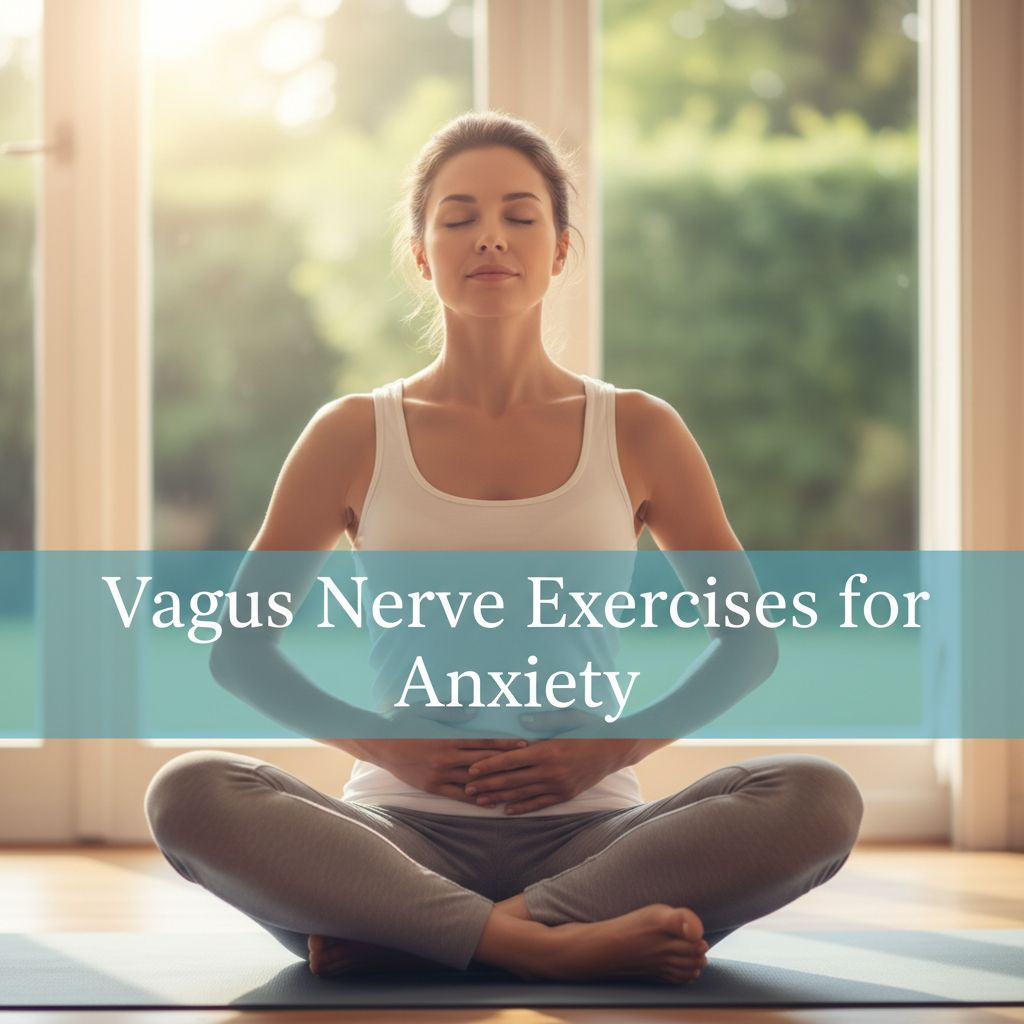
Your Full Daily Vagus Nerve Protocol
You don’t need to do all 12 exercises. What builds lasting anxiety resilience is consistency with a few well-chosen techniques across the day. This protocol takes approximately 30–40 minutes total, broken into short windows.
| Time of day | Technique(s) | Duration | Why it works |
| Morning (wake-up) | Physiological sigh × 3, then humming for 2–3 mins | 3–5 min | Resets morning cortisol spike; activates PNS before the day begins |
| Pre-work / commute | Extended exhale breathing (4–6 pattern) during transit | 5 min | Builds calm focus before entering work environment |
| Mid-morning (if anxious) | Cold water face splash or wrists; gargle with water for 30 secs | 2 min | Fast-acting reset for sudden anxiety spikes |
| Lunch break | 15-min walk with diaphragmatic breathing; lateral eye movements | 15 min | Combines movement, vagal activation, and bilateral stimulation |
| Pre-meeting anxiety | Box breathing (4-4-4-4) for 4 rounds; physiological sigh × 2 | 2–3 min | Measurable HRV improvement within minutes; calms pre-performance nerves |
| Evening wind-down | Cold shower (last 30 secs cold); then humming + body scan | 10–15 min | Accelerates sympathetic-to-parasympathetic transition |
| Before sleep | Legs up the wall pose (5–10 min); slow exhale breathing | 10 min | Activates baroreceptors; promotes melatonin and sleep onset |
| Start with just two: the Physiological Sigh each morning and Extended Exhale breathing for 5 minutes before bed. Do those for two weeks. Then add cold water and humming. Building gradually is more effective than attempting the full protocol from day one. |
How Long Does It Take to Build Vagal Tone?
This is the most common question — and the research gives a clear answer. Vagal tone improvement is measurable but cumulative. Here is what the evidence shows by timeframe:
| Timeframe | What changes | Key technique |
| Seconds–2 minutes | Immediate: heart rate drops, cortisol begins to reduce | Physiological Sigh, Cold Face Splash |
| 5–10 minutes | Sustained: HRV increases, anxiety intensity measurably drops | Extended Exhale, Box Breathing |
| 1–2 weeks | Short-term: baseline anxiety lowers, sleep quality begins improving | Daily breathing + cold shower |
| 4–8 weeks | Medium-term: HRV baseline rises, stress response becomes less intense | Full daily protocol |
| 3–6 months | Long-term: vagal tone substantially higher; anxiety resilience rebuilt | Consistent daily practice |
People Also Ask: Vagus Nerve Exercises for Anxiety, Answered
What are vagus nerve exercises?
Vagus nerve exercises are simple physical techniques that stimulate the vagus nerve — the body’s longest cranial nerve — to shift the nervous system from sympathetic (fight-or-flight) to parasympathetic (rest-and-digest) activation. Common techniques include the physiological sigh (double inhale, long exhale), cold water face exposure, extended exhale breathing, humming, gargling, and cold showers. They work by activating afferent vagal fibres that send calming signals upstream to the brainstem, reducing anxiety, lowering heart rate, and raising HRV.
Do vagus nerve exercises really work for anxiety?
Yes — the evidence base has grown substantially in 2025 and 2026. An August 2025 randomised controlled trial published in MDPI Applied Sciences found that a four-week vagal exercise protocol produced significant reductions in stress regulation and anxiety compared to controls. A Stanford 2023 RCT found that daily 5-minute cyclic sighing (the physiological sigh) produced greater mood improvement than mindfulness meditation. Cold facial exposure is supported by PMC research showing immediate, measurable heart rate drops via the dive reflex.
What is the fastest vagus nerve exercise for anxiety?
The physiological sigh is the fastest and most research-supported technique for immediate anxiety relief. It takes 30–90 seconds: two inhales through the nose (one normal, one short sniff at the top), followed by the longest possible exhale through the mouth. A Stanford RCT found it produces the fastest and most reliable reduction in physiological arousal of any breathwork technique. Cold water face exposure is the second fastest, triggering the mammalian dive reflex and producing measurable heart rate drops within seconds.
What is vagal tone and why does it matter?
Vagal tone refers to the baseline activity level of the vagus nerve — essentially, how active your parasympathetic nervous system is at rest. High vagal tone is associated with better emotional regulation, lower resting anxiety, better digestion, and stronger immune function. It is measured non-invasively via Heart Rate Variability (HRV): higher HRV indicates higher vagal tone. A 2025 PMC review confirmed that reduced HRV (low vagal tone) is associated with anxiety, depression, hypertension, and inflammation. Vagus nerve exercises measurably improve HRV over time.
How do I stimulate my vagus nerve quickly?
The three fastest techniques are: 1) The physiological sigh — double inhale, long exhale, takes 30 seconds; 2) Cold water on the face or wrists — triggers the dive reflex, takes 30 seconds; 3) Humming with a long exhale — vibration directly stimulates laryngeal vagal fibres, takes 60 seconds. For slightly longer but more sustained activation: extended exhale breathing (4 in, 6 out) for 5 minutes is one of the most well-evidenced techniques available.
Can you stimulate the vagus nerve through breathing?
Yes — breathing is the most accessible and most researched vagal stimulation method. Extended exhale breathing (making the exhale longer than the inhale) activates the vagus nerve via respiratory sinus arrhythmia — the natural coupling between breathing and heart rate. Six breaths per minute (5 seconds in, 5 seconds out) is known as the resonance frequency breathing rate and produces the largest measurable HRV increases of any breathing technique. A 2025 PMC review confirmed HRV biofeedback at resonance frequency significantly reduces anxiety and depressive symptoms.
Is cold water therapy good for the vagus nerve?
Yes. Cold water exposure activates the vagus nerve through two mechanisms: the mammalian dive reflex (triggered by cold water on the face) and the prolonged parasympathetic rebound after cold stress exposure. An August 2025 RCT found that four weeks of cold exposure significantly improved stress regulation and anxiety. Cold face splashing produces immediate heart rate drops; cold showers (30+ seconds of cold at the end) produce sustained vagal activation. Start with 15 seconds cold and build gradually.
What is the physiological sigh?
The physiological sigh is a naturally occurring breathing pattern — your body does it spontaneously when you are stressed or sleepy. It consists of a normal inhale followed immediately by a second, shorter sniff inhale that fully inflates the lungs, followed by a long, complete exhale. A Stanford 2023 RCT involving 114 participants found that deliberately practising physiological sighs for 5 minutes daily produced greater improvements in mood and lower respiratory rates than mindfulness meditation. It is the fastest known way to manually reduce physiological anxiety.
How does the vagus nerve affect anxiety?
The vagus nerve is the primary driver of the parasympathetic nervous system — the biological counterpart to the fight-or-flight stress response. When anxiety activates the sympathetic system (raising cortisol, adrenaline, and heart rate), the vagus nerve’s activation of the parasympathetic system is what brings it back down. Low vagal tone means the parasympathetic system is weak — the body reverts to anxiety states easily and recovers slowly. High vagal tone means a strong, responsive calming system that dampens anxiety quickly and efficiently. Vagus nerve exercises directly strengthen this calming capacity.
Can vagus nerve exercises replace therapy or medication?
No — and they should not be positioned as a replacement. Vagus nerve exercises are evidence-based anxiety management tools that produce real physiological benefits. They are most effective as part of a broader approach that may include therapy (particularly CBT or somatic therapies), medication where appropriate, sleep hygiene, and lifestyle factors. For diagnosed anxiety disorders, the evidence-based first-line treatments remain CBT and/or medication. Vagus nerve exercises are an excellent complement to those treatments — accessible, free, and with no side effects.
Going Deeper: Books and Resources on Vagus Nerve Health
If you want to understand the science more deeply or build a more structured practice, these resources are worth exploring:
- The Polyvagal Theory in Therapy — Deb Dana. The most accessible introduction to Stephen Porges’ Polyvagal Theory and its application to trauma and anxiety. [INSERT Amazon link — tag=smg00ab-20]
- Accessing the Healing Power of the Vagus Nerve — Stanley Rosenberg. Practical exercises rooted in clinical practice, including the Basic Exercise and craniosacral techniques. [INSERT Amazon link — tag=smg00ab-20]
- The Vagus Nerve Healing Handbook — Nina M. An accessible 21-day protocol with science-backed exercises for nervous system reset. [INSERT Amazon link — tag=smg00ab-20]
- Headspace or Calm apps — both include breathing exercises that activate the vagus nerve. Headspace’s SOS meditations and Calm’s breathing bubbles are good starting points. [INSERT affiliate links via respective affiliate programs]
Final Thoughts: Your Nervous System Has a Reset Button
The vagus nerve is not a wellness trend. It is the physiological infrastructure of your calm. It has always been there — running from your brainstem through your throat, your heart, your lungs, your gut — waiting to be activated.
The 12 techniques in this guide are not new inventions. They are the systematised, research-backed rediscovery of what humans have always done to regulate emotional states: singing, chanting, cold water, slow breath, movement. What is new is the science that explains why they work so rapidly and so reliably — and the tools to measure that they are working (HRV) in real time.
Start with the physiological sigh. Do it right now, before you close this article. Two inhales through the nose, one long exhale through the mouth. Feel the difference. That’s your vagus nerve. That’s the reset button you’ve always had.
At ResetMindHub.com, we believe the most powerful mental health tools are often the ones that cost nothing and live inside your own body.
| The Physiological Sigh. Right now. Two inhales through the nose, one long exhale through the mouth. You’ve just activated your vagus nerve. That feeling of settling is real, measurable, and repeatable. |
🚨 When Anxiety Needs More Than a Reset
Vagus nerve exercises are powerful tools for managing everyday anxiety. They cannot treat diagnosed anxiety disorders, trauma, OCD, PTSD, or panic disorder on their own. If your anxiety is significantly affecting your daily life, please speak to a licensed mental health professional. BetterHelp and Talkspace offer access to licensed therapists within 24–48 hours. If you are in crisis, call or text 988 — the Suicide & Crisis Lifeline — available 24/7.
Related Reading on ResetMindHub.com:
- Panic Attack Natural Remedies That Actually Work
- Best Mindfulness Courses for Stress Relief in 2026
- L-Theanine vs Ashwagandha for Anxiety: Which Should You Take?
- Best Online Therapy That Takes Insurance in 2026
Disclaimer: This article is for informational purposes only and does not constitute medical advice. Vagus nerve exercises are wellness practices and are not a treatment for diagnosed medical or mental health conditions. Always consult a qualified healthcare provider before beginning any new health practice, particularly if you have a pre-existing cardiovascular, neurological, or other medical condition.



Pingback: Panic Attack Natural Remedies That Actually Work - Reset Mind Hub
Pingback: Best CBT Workbooks for Anxiety and Depression in 2026 - Reset Mind Hub
Pingback: How to Stop Overthinking at Night: Science-Backed Techniques to Quiet a Busy Mind - Reset Mind Hub