You’ve tried the breathing app. You’ve tried the journal that sits half filled on your nightstand. You’ve tried the yoga class your friend swore by.
None of it stuck.
Here’s what nobody told you: stress advice fails you not because you lack willpower. It fails because you never found out what kind of stress you’re actually dealing with.
Stress Isn’t One Thing
Most people treat stress like a single problem with a single fix. Breathe deeper. Sleep more. Meditate. Done.
But stress shows up in different bodies and different minds in completely different ways. Researchers who study stress responses split it into distinct categories: cognitive, physical, and emotional or socio-evaluative stress each activate different systems in your brain and body.
That’s not a small detail. It’s the whole reason your advice keeps missing the mark.
If your stress lives in your head, a yoga class won’t touch it. If your stress lives in your shoulders and jaw, a journaling habit won’t release it. You’ve been handed a one-size-fits-all solution for a problem that was never one-size-fits-all.
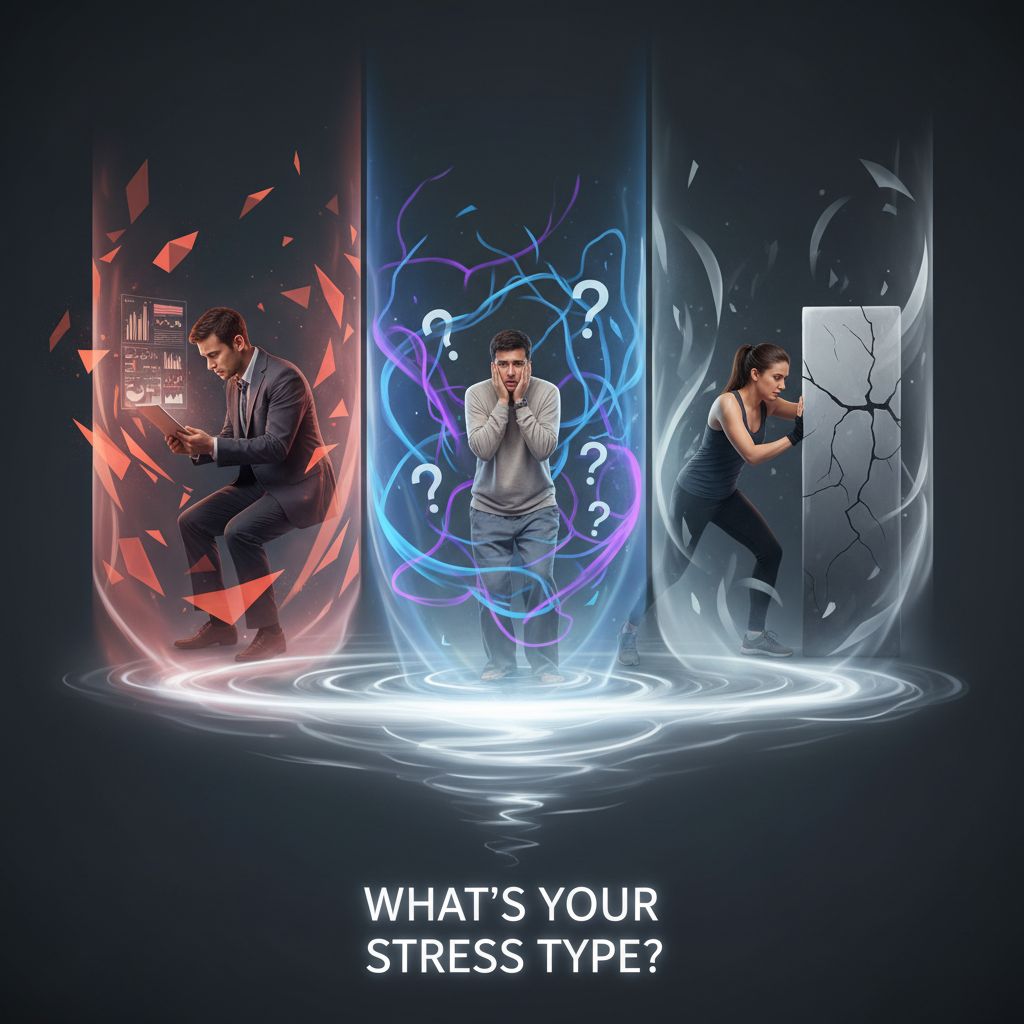
Stress feels different for everyone. What's your type?
Take the free 2-minute Stress Reset Assessment and find out.
Take the Free Stress Test →The Three Stress Types (And How to Spot Yours)
Take a second and think about your worst stressed-out moment this month. What did it actually feel like?
| Stress Type | What It Feels Like | What You Actually Need |
|---|---|---|
| Cognitive Overwhelm | Racing thoughts, mental fog, can’t switch off, replaying conversations at 2am | A brain dump, not a meditation app |
| Physical Tension | Tight jaw, clenched shoulders, shallow breath, restless legs | Movement, not more thinking |
| Social or Emotional Pressure | Fear of judgment, people-pleasing spirals, dread before meetings or events | Boundaries and grounding, not productivity hacks |
You might see yourself in more than one. Most people do. But almost everyone has a dominant type, the one that shows up first and hits hardest.
Cognitive Overwhelm
This is the mind that won’t quiet down. You lie in bed replaying your to-do list. You can’t finish one thought before three more crowd in.
Meditation apps often make this worse before they help, because sitting still with a loud mind feels like torture. What actually works: get the thoughts out of your head and onto paper. A messy, unfiltered brain dump does more for cognitive stress than ten minutes of forced stillness ever will.
Physical Tension
Your stress doesn’t live in your thoughts. It lives in your body. Your shoulders creep up toward your ears. Your jaw aches by 3pm. You feel keyed up even when nothing specific is on your mind.
For this type, thinking your way out won’t work. Moving your way out will. A walk, a stretch, a few minutes of shaking out your arms and legs tells your nervous system the danger has passed.
Social or Emotional Pressure
This type shows up as a knot in your stomach before a meeting, a script you rehearse in your head before sending a text, a constant scan of the room to check if everyone’s okay with you.
Breathing exercises and to-do lists barely scratch this. What helps is naming the pressure out loud, setting one small boundary, and giving yourself permission to disappoint someone occasionally. That’s the muscle this type needs to build.
Why This Changes Everything
Think about the last time you tried a stress technique that just didn’t land.
Chances are, it was the right tool for the wrong type.
You told a Cognitive Overwhelm friend to “just relax” and watched them get more agitated. You handed a Physical Tension person a journal when what they needed was to run around the block. You gave a Social Pressure type a productivity system when what they needed was one honest conversation.
Once you know your type, you stop guessing. You stop collecting wellness advice that sounds good on paper and does nothing for you personally. You start building a stress response that actually fits how your mind and body work.
Your Next Step
You don’t have to figure this out alone or through trial and error for the next five years.
Take the free 2-minute stress type test and find out exactly which type you are, and exactly which techniques will work for your nervous system, not someone else’s.
Once you know your type, everything else gets easier. The right breathing technique. The right movement. The right boundary. All of it starts with one answer: what’s your stress type?
Take the free 2-minute stress type test →
Curious how your stress type connects to your mornings, your sleep, or your mindfulness practice? Check out our guides on building a calmer morning ritual and simple meditation habits that actually stick for your type.