Why Your Brain Goes Into Overdrive at Bedtime — and 12 Evidence-Based Techniques to Finally Stop It
| 📎 Affiliate Disclosure |
| This article contains affiliate links. If you subscribe to an app or sign up for a therapy platform through a link on this page, ResetMindHub.com may earn a commission at no extra cost to you. App and therapy recommendations are based on clinical evidence and quality — not commission rates.
This article is for informational purposes only and does not constitute medical advice. If overthinking and insomnia are significantly affecting your daily life, please consult a licensed mental health professional. |
-
Learn How to Stop Overthinking at Night. It’s 2am. You’re exhausted. And your brain has decided that right now — in the dark, alone, when there is nothing you can do about any of it — is the perfect time to replay every awkward conversation from the last three years and pre-live every catastrophe that might happen tomorrow. You are not broken. This is biology. And it has a solution.
Explore the Full Reset Mind Method
This guide focuses on nighttime overthinking specifically — but it’s one piece of a larger system. If the techniques here help, these hubs go deeper into the other areas that shape your baseline stress:
- Overthinking & Rumination — if the loop you’re dealing with isn’t just at night, this hub covers interrupting it in the moment, brain fog, and mindfulness tools.
- Burnout & Chronic Stress — for when the problem feels bigger than any single night’s rumination, and has been building for weeks or months.
- Create a Calm Physical Space — your bedroom environment plays a direct role in nighttime overthinking; this covers decluttering, sensory setup, and weighted blankets.
- Morning Regulation — how you start the day affects your cortisol trajectory by the time you’re back in bed that night.
- Pacing — task-hopping and poor energy management during the day are common hidden contributors to a mind that won’t switch off at night.
- Micro-Resets — 30-second to 5-minute techniques for interrupting stress before it has a chance to build toward bedtime.
- Stress Management by Profession — if your overthinking is shaped by the specific pressures of your job, start here.
- Support & Treatment Options — for when nightly techniques aren’t enough on their own, including therapy formats, supplements, and honest reviews of stress assessments.
Why does my brain start overthinking as soon as I go to bed?
What is a “brain dump,” and how does it help you sleep?
Nighttime overthinking is one of the most searched mental health topics in the United States — and one of the most misunderstood. Most articles offer surface-level advice: try deep breathing, avoid your phone, count sheep. This guide goes deeper. It explains the exact neurological reason your brain overthinks at night more than it does during the day, identifies the six distinct types of nighttime overthinking and which techniques address each one, and gives you 12 evidence-based tools plus a complete wind-down protocol you can use tonight.
No meditation app required. No expensive gadgets. Just the neuroscience of why this happens and the practical tools that research confirms actually work.
Nighttime Overthinking:
| The Root Cause | Why It Happens at Night | Science-Backed Technique | How It Quiets the Mind |
| The “Stimulus Control” Failure | The bed has become associated with stress and problem-solving instead of rest. | The 20-Minute Rule (Stimulus Control) | If awake after 20 minutes, leave the bedroom. Do a low-stimulation activity until sleepy to reset the brain’s association with the bed. |
| Cognitive Hyperarousal | Unresolved tasks and worries trigger the brain’s “threat detection” system (amygdala). | Brain Dumping / Expressive Writing | Writing a structured to-do list or journaling 2 hours before bed unloads working memory, signaling to the brain that tasks are managed. |
| Autonomic Nervous System Imbalance | Cortisol and adrenaline remain elevated, keeping the body in a “fight-or-flight” state. | 4-7-8 Breathing or Box Breathing | Prolonged exhalations activate the vagus nerve, triggering the parasympathetic nervous system to lower heart rate. |
| Attentional Fixation | The brain fixates on the negative consequences of not sleeping, creating a stress loop. | Cognitive Shuffling (Serial Diverse Imagination) | Force the brain to imagine random, non-threatening words or images. This mimics the chaotic imagery of early sleep, tricking the brain into transitioning. |
Why Your Brain Overthinks at Night: The Neuroscience
The Default Mode Network Wakes Up
During the day, your brain is engaged with external tasks — work, conversations, decisions, movement. This engagement suppresses a neural network called the Default Mode Network (DMN) — the circuit responsible for self-referential thought, mental time-travel (replaying the past, imagining the future), and social evaluation. The DMN is essentially your brain’s ‘internal narration system.’
When you lie down at night and external stimulation fades, the DMN activates strongly. As 2026 psychology researcher Isabella Chase describes it: ‘Nighttime overthinking is the brain’s attempt to complete emotional processing it couldn’t finish during the busy daylight hours.’ Your brain is not malfunctioning — it is doing exactly what it is designed to do, just at a very inconvenient time.
The Prefrontal Fatigue Gap
Your prefrontal cortex — the rational, regulatory part of your brain responsible for logical evaluation and emotional dampening — is exhausted by the end of the day. It has been making decisions and regulating impulses for 16 hours. The amygdala, your brain’s emotional alarm system, does not fatigue in the same way — it remains highly active at night. The result: emotions that felt manageable at 2pm feel overwhelming at 2am. This is not catastrophizing. It is neurological fact.
Stress feels different for everyone. What's your type?
Take the free 2-minute Stress Reset Assessment and find out.
Take the Free Stress Test →Cortisol Dysregulation
In people with anxiety and chronic overthinking, cortisol — the primary stress hormone — is frequently dysregulated at night. Instead of following the natural pattern (high in the morning, declining through the day, lowest at night), it remains elevated at bedtime, keeping the nervous system in a state of physiological hyperarousal. A dysregulated HPA axis produces a brain that literally cannot downshift at night, regardless of how tired the body feels. This explains the paradox of feeling exhausted but unable to sleep.
| DMN
Default Mode Network: the neural circuit that drives self-referential overthinking when external stimulation fades |
2am
When prefrontal fatigue is highest and amygdala reactivity is unfiltered — why thoughts feel catastrophic at night |
6 types
Distinct types of nighttime overthinking, each with different optimal interventions |
The 6 Types of Nighttime Overthinking
Not all overthinking is the same. Identifying which type is keeping you awake points you to the most effective intervention. Most people experience two or three types simultaneously.
| Type of overthinking | What it looks like | Best technique |
| Rumination | Replaying past events, conversations, or mistakes | Cognitive defusion, journaling, self-compassion practice |
| Worry | Future-focused ‘what if’ catastrophizing | Scheduled worry time, cognitive restructuring (CBT) |
| Problem-solving | Trying to resolve genuinely unresolved issues at 2am | To-do capture list before bed; remind yourself 2am is not a good problem-solving time |
| Social replay | Replaying social interactions, worrying about judgement | Cognitive defusion; ‘would I judge someone else this harshly?’ |
| Hypervigilance | Monitoring bodily sensations or sounds for threat | Body scan; grounding techniques; vagus nerve activation |
| Identity rumination | Deep questions about life direction, meaning, choices | Journaling to externalize; therapy to address the root questions |
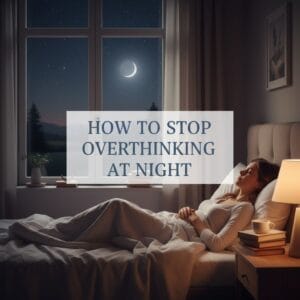
12 Science-Backed Techniques to Stop Overthinking at Night
Organized from fastest-acting to longer-term habit builders. Techniques 1–6 can be used in bed tonight. Techniques 7–12 build the structural conditions that prevent overthinking from starting.
| #1 📝 The Worry Dump — Scheduled Pre-Sleep Writing
The Single Most Effective Nighttime Overthinking Intervention |
|
| Why it works:
Writing worries down before bed externalizes cognitive load — the brain stops holding and rehearsing information it has already recorded. A Penn State University study found that designating a specific 15–30 minute worry period during the day and writing a to-do list before bed significantly reduced sleep onset latency. A 2018 Baylor University study found that spending 5 minutes writing a specific to-do list for the following day helped people fall asleep an average of 9 minutes faster. How to do it: 1. 30–60 minutes before bed, take a notebook (not your phone) 2. Write down every worry, unresolved task, and recurring thought 3. For each worry: note it, then write one concrete next action 4. For unanswerable worries: write ‘I cannot resolve this tonight. I will revisit it at [specific time].’ 5. Close the notebook physically. This is the ritual signal: these thoughts are recorded and contained. |
Time needed
5–15 minutes Evidence ★★★★★ Penn State + Baylor University RCTs Best used Every evening, 30–60 mins before bed |
| ⚡ Pro tip: Use a physical notebook, not your phone. The act of writing by hand activates different neural processing than typing and creates a stronger psychological sense of completion. | |
| #2 💨 4-7-8 Breathing
Activates the Parasympathetic Nervous System in 4 Cycles |
|
| Why it works:
The 4-7-8 breathing technique is based on pranayama (yogic breathing) and is designed to activate the parasympathetic nervous system while giving the overthinking brain a structured task. The extended hold (7 seconds) and long exhale (8 seconds) directly stimulate the vagus nerve and shift the body from sympathetic to parasympathetic dominance. It is one of the fastest techniques for reducing physiological arousal that amplifies nighttime rumination. How to do it: 1. Lie in bed with lights off 2. Inhale quietly through your nose for 4 seconds 3. Hold your breath for 7 seconds 4. Exhale completely through your mouth, making a whoosh sound, for 8 seconds 5. Repeat for 4 complete cycles 6. If you feel light-headed, slow the tempo — the ratios matter more than speed |
Time needed
2–3 minutes Evidence ★★★★☆ Pranayama and vagal activation research Best used In bed after lights out |
| ⚡ Pro tip: The 7-second hold is what distinguishes this from standard box breathing. The CO₂ build-up during the hold triggers the body’s natural relaxation reflex on the exhale. | |
| #3 🧠 Cognitive Defusion — The ACT Technique for Thought Detachment
Change Your Relationship With Thoughts Without Fighting Them |
|
| Why it works:
Cognitive defusion is a core ACT (Acceptance and Commitment Therapy) technique that changes your relationship with overthinking thoughts rather than trying to stop or challenge them. Research shows that attempting to suppress thoughts (the common ‘stop thinking about it’ approach) paradoxically increases their frequency — the white bear problem. Defusion sidesteps this by creating psychological distance between you and the thought. How to do it: 1. When a thought arises, notice it without engaging: ‘I notice I’m having the thought that…’ 2. Imagine the thought as a leaf floating past on a stream — you can see it, but you’re not on the leaf 3. Or: say the thought out loud in a silly voice or slow motion — this breaks the emotional charge 4. Or: label the thought type: ‘That’s a worry thought. That’s a planning thought.’ 5. Return attention to your breath or body sensations without judging the thought |
Time needed
Ongoing (2–5 min practice) Evidence ★★★★★ ACT research — extensive RCT support Best used In bed; when thoughts feel intrusive |
| ⚡ Pro tip: The goal is not to make the thought go away. It is to stop giving it your full attention. The thought can be there without being the thing you are doing. | |
| #4 💤 Progressive Body Scan
Moves Attention From Thoughts to Physical Sensations |
|
| Why it works:
The body scan redirects attention from the abstract mental realm of overthinking (where the DMN operates) to concrete, present-moment physical sensation (which the DMN cannot simultaneously occupy). Research on mindfulness-based interventions consistently shows that sustained attention to body sensations interrupts the rumination loop and lowers physiological arousal before sleep. How to do it: 1. Lie flat in bed, arms at your sides 2. Start with your toes — notice any sensations without trying to change them 3. Slowly move attention upward: feet, calves, knees, thighs, hips 4. Continue through abdomen, chest, hands, arms, shoulders, neck, face 5. When your mind wanders (it will), gently return attention to wherever you left off 6. The goal is not relaxation — it is attention. Relaxation often follows naturally. |
Time needed
10–20 minutes Evidence ★★★★☆ MBSR and body scan research Best used In bed after lights out; especially when anxious |
| ⚡ Pro tip: If you fall asleep mid-scan, that’s a success. Most people fall asleep somewhere between the knees and shoulders. You don’t have to finish. | |
| #5 🌙 Stimulus Control Therapy — The CBT-I Protocol
Breaks the Bed-Wakefulness Association That Chronic Overthinkers Build |
|
| Why it works:
Stimulus control therapy is a core component of CBT-I (Cognitive Behavioral Therapy for Insomnia) with some of the strongest evidence in sleep medicine. It works by preserving the conditioned association between bed and sleep — which chronic overnight overthinkers erode by spending hours awake in bed. Research confirms that stimulus control significantly reduces sleep onset latency and waketime after sleep onset. How to do it: 1. If you are still awake and overthinking after approximately 20 minutes in bed 2. Get out of bed. Do not lie there trying harder. 3. Go to another room with dim lighting 4. Do a genuinely low-arousal activity: fold socks, read something dull, do gentle stretching 5. Do NOT use your phone, watch TV, or do anything stimulating 6. Return to bed only when you feel genuinely sleepy — eyes heavy, body slow 7. Repeat as many times as needed. This builds the association over days and weeks. |
Time needed
As needed Evidence ★★★★★ CBT-I core component — extensive clinical validation Best used When awake in bed for 20+ minutes |
| ⚡ Pro tip: This feels counterintuitive — getting up seems to make sleep harder. It doesn’t. It preserves the bed-sleep cue that overthinking destroys. Give it two weeks of consistent practice. | |
| #6 📵 NSDR — Non-Sleep Deep Rest Protocol
Achieves Deep Physiological Rest Even When Sleep Won’t Come |
|
| Why it works:
NSDR (Non-Sleep Deep Rest) is a protocol developed by neuroscientist Dr. Andrew Huberman based on yoga nidra research. It involves lying still while following a guided audio that directs attention through body sensations and imagery — inducing theta brain wave states associated with deep rest and neurochemical restoration. Unlike trying to sleep, NSDR removes the performance pressure by reframing the goal as rest rather than sleep. How to do it: 1. When you cannot sleep and feel the pressure mounting, reframe the goal: rest, not sleep 2. Find a free NSDR audio on YouTube or Spotify (search ‘NSDR protocol’ — 10 or 20 minute versions) 3. Lie flat, headphones in, and follow the guidance 4. Allow the body to be completely still while the audio guides attention 5. Many people fall asleep during NSDR; others complete it fully rested without sleeping |
Time needed
10–20 minutes Evidence ★★★★☆ Yoga nidra and theta-state research Best used When sleep feels impossible; when sleep anxiety is high |
| ⚡ Pro tip: NSDR removes the performance anxiety of trying to sleep. When the goal is rest rather than sleep, the nervous system stops fighting itself — and sleep often follows. | |
| #7 📓 Scheduled Worry Time
Contains Anxiety to a Defined Window — Keeps It Out of Bed |
|
| Why it works:
Scheduled worry time is one of the most well-validated CBT techniques for generalized anxiety and nighttime rumination. Penn State University research found that assigning a specific daily ‘worry period’ and actively postponing worries to that period when they arise at other times significantly reduces nighttime rumination. The technique works by training the brain to trust that worries will be addressed — so it does not need to keep them active. How to do it: 1. Choose a specific daily worry window: 20–30 minutes, the same time every day, at least 2 hours before bed 2. When a worry arises at any other time (including in bed), note it briefly and actively postpone: ‘I’ll think about that during worry time’ 3. During your worry window: write out worries fully, categorize them (solvable vs unsolvable), and note one action for each solvable worry 4. When the window closes, close the notebook and move on 5. Worries that arise in bed: remind yourself they are scheduled. The brain eventually learns to wait. |
Time needed
20–30 min daily Evidence ★★★★★ Penn State RCT evidence Best used Daily practice, 2+ hours before bed |
| ⚡ Pro tip: It takes 1–2 weeks for the brain to trust the system. The first few nights, worries will still come at bedtime. Note them and defer: ‘This is scheduled for tomorrow at 5pm.’ | |
| #8 🚶 Daytime Exercise — The Best Long-Term Overthinking Prevention
Reduces Cognitive Rumination and Nighttime Cortisol Simultaneously |
|
| Why it works:
Aerobic exercise is the most evidence-supported long-term intervention for both anxiety and insomnia. It reduces baseline cortisol, raises the threshold at which the stress response activates, and has been shown in multiple studies to reduce cognitive rumination — the repetitive negative thinking that drives nighttime overthinking. A 2016 meta-analysis confirmed that regular exercise significantly improves sleep quality across insomnia populations. How to do it: 1. 150 minutes of moderate aerobic exercise per week (5 × 30-minute sessions) 2. Morning or early afternoon exercise is optimal for circadian alignment 3. Avoid vigorous exercise within 2–3 hours of bed (raises cortisol) 4. Even a 20-minute brisk walk significantly reduces rumination in the hours following 5. Zone 2 exercise (conversational pace) is most sustainable and has the strongest cortisol-reduction evidence |
Time needed
30 min daily (4–8 week cumulative benefit) Evidence ★★★★★ Meta-analysis of multiple RCTs Best used Daytime habit for nighttime benefit |
| ⚡ Pro tip: A 20-minute walk after dinner has two effects: it reduces post-meal glucose spikes that disrupt sleep, and it provides a cortisol-reducing movement window that dampens the overnight stress response. | |
| #9 🌙 The Digital Sunset — 2-Hour Pre-Sleep Screen Cutoff
Prevents the Primary Environmental Trigger for Nighttime Overthinking |
|
| Why it works:
Blue light from screens suppresses melatonin production, delaying sleep onset. But the deeper issue is content: social media, news, and email all activate the amygdala’s threat-detection and social comparison circuits — the same circuits that drive nighttime rumination. Stopping screen use 2 hours before bed eliminates the primary environmental fuel for the DMN’s evening activation. How to do it: 1. Set a phone alarm named ‘Digital Sunset’ for 2 hours before your target sleep time 2. At the alarm: put your phone in another room or a drawer (out of sight matters) 3. Replace the screen habit with a low-stimulation activity: reading fiction, gentle stretching, bath, herbal tea 4. If you must use a device, blue-light glasses and night mode reduce but do not eliminate the melatonin-suppression effect 5. Charge your phone outside your bedroom — this single change improves sleep for most people who try it |
Time needed
2 hours before bed Evidence ★★★★★ Blue light and circadian rhythm research Best used Every evening — non-negotiable habit |
| ⚡ Pro tip: The phone in another room is more powerful than blue-light glasses. The glasses address melatonin. The removed phone addresses the behavioral compulsion to check it. Both matter; the physical separation matters more. | |
| #10 🚷 Paradoxical Intention
The Counterintuitive Technique That Removes Sleep Performance Anxiety |
|
| Why it works:
Paradoxical intention is a CBT technique that instructs the insomniac to try to stay awake rather than trying to sleep. Research shows it reduces sleep performance anxiety — the heightened arousal created by trying to force sleep — by removing the pressure of the attempt. Multiple studies show it reduces sleep onset latency by reducing the arousal that the effort of trying to sleep creates. How to do it: 1. When you find yourself trying hard to fall asleep, reverse the goal 2. Lie still with your eyes open (or closed) and actively try to stay awake 3. Do not do anything stimulating — just try to remain conscious 4. Notice the irony: trying to stay awake is boring. The body’s natural sleep pressure takes over. 5. This technique is most effective when sleep anxiety (‘I’m never going to sleep’) is the primary barrier |
Time needed
As needed Evidence ★★★☆☆ CBT-I paradoxical intention research Best used When trying to force sleep makes things worse |
| ⚡ Pro tip: Do not use this technique with stimulating content. The goal is genuinely boring wakefulness — lying still, eyes open, trying to resist sleep. The monotony does the work. | |
| #11 🌬️ Physiological Sigh Before Sleep
The Fastest Physiological Intervention for Bedtime Anxiety |
|
| Why it works:
The physiological sigh — double inhale through the nose followed by a long exhale through the mouth — is the fastest known method for reducing acute physiological arousal. A Stanford 2023 RCT found it produced greater improvements in physiological arousal than any other breathwork technique tested. Used at bedtime before any other technique, it immediately lowers the physiological intensity of overthinking. How to do it: 1. As you settle into bed: take a normal inhale through your nose 2. At the top, sniff in a second short breath to fully inflate your lungs 3. Release both with one long, slow exhale through your mouth 4. Repeat 3–5 times 5. Then transition to 4-7-8 breathing or body scan |
Time needed
30–90 seconds Evidence ★★★★★ Stanford 2023 RCT Best used First technique to use each night |
| ⚡ Pro tip: Use the physiological sigh as your bedtime anchor technique — the consistent first step before any other intervention. Done every night, it becomes a conditioned relaxation cue. | |
| #12 📚 Journaling — Expressive Writing to Process the Day
Completes the Emotional Processing the DMN Is Trying to Do |
|
| Why it works:
Research by James Pennebaker (University of Texas) established that expressive writing about difficult emotions and experiences produces measurable reductions in physiological stress markers, anxiety, and rumination. The mechanism: writing externalizes the emotional processing that the DMN attempts at night, completing it earlier in the evening when the prefrontal cortex can participate constructively. How to do it: 1. 15–20 minutes before bed, write freely about anything that’s on your mind 2. Do not edit or judge what you write — the goal is externalization, not quality 3. Include emotions, not just events: ‘I felt X when Y happened, and I’m worried about Z’ 4. End each entry with one thing you’re grateful for — research shows gratitude journaling shifts DMN activity from threat-focused to positive future-focused 5. Close the journal and leave it closed. The evening’s processing is done. |
Time needed
10–20 minutes Evidence ★★★★★ Pennebaker RCT + gratitude journaling research Best used 30–45 mins before bed |
| ⚡ Pro tip: Gratitude is not toxic positivity — it is a neurological intervention. Research shows gratitude journaling measurably shifts DMN activity away from threat-scanning. Even one genuine item changes the night’s cognitive baseline. | |
Your Complete Wind-Down Protocol for Tonight
You don’t need all 12 techniques. You need a consistent sequence that you practice every night until it becomes automatic. Here is a complete protocol built from the highest-evidence techniques:
| Timing | Action | Why it works |
| 2 hours before bed | Digital sunset | Turn off all screens. Put your phone in another room or on Do Not Disturb. Blue light suppresses melatonin; social media activates the comparison/threat-scan circuits that fuel overthinking. |
| 90 mins before bed | Worry dump | Write all current worries, tasks, and unfinished thoughts onto paper. Studies show this externalizes cognitive load and measurably reduces sleep onset latency. The brain stops rehearsing what it has already recorded. |
| 60 mins before bed | Wind-down ritual | Warm shower or bath (the subsequent body temperature drop signals sleep onset), herbal tea (chamomile or lemon balm), gentle reading (fiction, not news), or light stretching. Consistent ritual anchors the circadian signal. |
| 30 mins before bed | 4-7-8 breathing | 4 seconds in, 7 seconds hold, 8 seconds out. Repeat 4 cycles. Activates the parasympathetic nervous system and reduces the physiological arousal that amplifies overthinking. Do this in bed with lights off. |
| In bed, lights off | Body scan or NSDR | Progressive body scan from feet to head, releasing each muscle group. Or Non-Sleep Deep Rest (NSDR): a guided 10-minute protocol that puts the brain into theta-wave state — physiologically restorative even if sleep doesn’t follow immediately. |
| If still awake at 20 min | Stimulus control exit | Get out of bed. Go to a dim room. Do a low-arousal activity (fold clothes, read something dull) until sleepy. Return to bed. This preserves the bed-sleep association that overthinking erodes. Core component of CBT-I. |
| The most important word in that protocol is ‘consistent.’ Any single technique used once will have modest effects. The same techniques used every night for two weeks build conditioned cues that accelerate the parasympathetic shift. Habit is the mechanism. |
What to Skip — and Why It’s Making Things Worse
| What to skip | Why it backfires | Do this instead |
| Scrolling your phone in bed | Activates the amygdala’s social comparison and threat-detection circuits; blue light suppresses melatonin | 4-7-8 breathing or body scan |
| Watching stimulating TV | Raises cortisol and prolongs the sympathetic state that makes overthinking worse | Fiction reading or NSDR protocol |
| Rehearsing tomorrow’s tasks | Activates the same planning circuits that created the overthinking loop in the first place | Scheduled worry time earlier in the evening |
| Alcohol as a sleep aid | Suppresses REM sleep and worsens morning cortisol; temporary sedation followed by reactive wakefulness | Magnesium glycinate + chamomile tea |
| Lying in bed awake past 20 minutes | Strengthens the association between bed and wakefulness; the core mechanism that perpetuates chronic insomnia | Stimulus control: get up, do low-arousal activity |
| Trying to force sleep | Increases sleep performance anxiety, raising arousal and making sleep less likely (the ‘trying’ paradox) | Paradoxical intention: try to stay awake instead |
| Checking the time repeatedly | Creates clock-watching anxiety and reinforces the sense of time passing without sleep | Turn your clock or phone face away from you |
When Nighttime Overthinking Is a Sign of Something More
Occasional nighttime overthinking is universal. Chronic, nightly rumination that significantly affects sleep quality, mood, and daily functioning for weeks or months is a clinical concern. The following warrant professional support:
- Nighttime overthinking that has persisted for more than 4 weeks despite self-help efforts
- Sleep deprivation from overthinking that is affecting your work, relationships, or safety (driving tired)
- Overthinking that is accompanied by persistent low mood, hopelessness, or significant anxiety during the day
- Racing thoughts that feel out of control, pressured, or accompanied by elevated mood (which may indicate mania)
- Intrusive, unwanted thoughts that cause significant distress (OCD-spectrum)
CBT-I (Cognitive Behavioral Therapy for Insomnia) is the gold-standard treatment for chronic insomnia and is more effective than sleep medication in the long term. Standard CBT and ACT are highly effective for the anxiety and rumination driving the overthinking. Both are available through online therapy platforms.
| BetterHelp and Talkspace offer CBT-trained therapists specializing in anxiety and sleep within 24–48 hours. If you have insurance, Talkspace is in-network with most major plans with copays from $0. [INSERT affiliate links] |
People Also Ask: How to Stop Overthinking at Night, Answered
Why do I overthink so much at night?
Nighttime overthinking is primarily caused by the activation of the brain’s Default Mode Network (DMN) when external stimulation fades. During the day, focused tasks suppress the DMN. At night, with nothing to focus on externally, the brain shifts inward to process unfinished emotional business, plan for the future, and replay the past. This is compounded by prefrontal fatigue (your logical brain is exhausted and less able to regulate the emotional brain) and, in anxious individuals, elevated nighttime cortisol that keeps the nervous system in a state of hyperarousal.
What is the fastest way to stop overthinking at night?
The physiological sigh (double inhale through the nose, long exhale through the mouth, 3–5 repetitions) is the fastest technique for reducing physiological arousal. Follow immediately with 4-7-8 breathing (4 in, 7 hold, 8 out, 4 cycles) and a body scan. For the cognitive layer of overthinking, cognitive defusion (labelling thoughts as ‘there’s a worry thought’ and returning to the breath) is the most immediately effective technique. Used together, these address both the physiological and cognitive dimensions of nighttime overthinking within 5–10 minutes.
What is the 4-7-8 breathing technique?
The 4-7-8 technique involves inhaling through the nose for 4 seconds, holding the breath for 7 seconds, and exhaling through the mouth for 8 seconds. The extended hold and long exhale activate the vagus nerve and shift the body from sympathetic (fight-or-flight) to parasympathetic (rest-and-digest) dominance. It gives the overthinking brain a simple structured task while physically slowing the heart rate and reducing the cortisol-driven arousal that fuels nighttime rumination. Repeat for 4 full cycles for maximum effect.
Does journaling help with nighttime overthinking?
Yes — research by James Pennebaker at the University of Texas established that expressive writing measurably reduces anxiety and rumination by externalizing the emotional processing the DMN attempts at night. A Baylor University study found that writing a specific to-do list for the next day helped people fall asleep an average of 9 minutes faster. Journaling 15–20 minutes before bed — including emotions, not just events, and ending with one genuine gratitude — completes the evening’s emotional processing before you reach your bed.
Why does overthinking get worse when I try to stop it?
This is known as the white bear problem (or ironic process theory), documented by psychologist Daniel Wegner. When you try to suppress a thought (‘stop thinking about X’), the effort of monitoring for the thought to suppress it paradoxically activates the very neural circuit producing the thought — increasing its frequency. The effective alternative is cognitive defusion (from ACT): instead of suppressing the thought, you observe it without engaging: ‘I notice I’m having the thought that…’ This reduces the thought’s power without triggering the suppression backfire effect.
What is stimulus control therapy for insomnia?
Stimulus control therapy is a core CBT-I technique that breaks the conditioned association between bed and wakefulness that chronic overthinkers develop. The protocol: use your bed only for sleep (and sex); if you are still awake after approximately 20 minutes, get out of bed, go to a dimly lit room, do a low-arousal activity until genuinely sleepy, then return to bed. This is repeated as many times as needed. Research shows it significantly reduces sleep onset latency and nighttime waketime over 1–2 weeks of consistent practice.
Does exercise help with overthinking at night?
Yes — regular aerobic exercise is one of the most effective long-term interventions for both nighttime rumination and insomnia. It reduces baseline cortisol, raises the anxiety threshold, and has been shown to reduce cognitive rumination in the hours following a session. A 2016 meta-analysis confirmed regular exercise significantly improves sleep quality. Morning or early afternoon exercise is optimal. Avoid vigorous exercise within 2–3 hours of bed as it raises cortisol temporarily.
What is the best app for overthinking at night?
Calm is the strongest choice specifically for nighttime overthinking and sleep — its Sleep Stories, ambient soundscapes, and Daily Calm are best-in-class for pre-sleep use. Headspace has excellent bedtime meditations and body scans. Insight Timer is completely free with thousands of sleep meditations. For NSDR protocols specifically, Andrew Huberman’s NSDR audio is available free on YouTube and Spotify. [INSERT Calm and Headspace affiliate links]
Is nighttime overthinking a sign of anxiety?
Frequent nighttime overthinking is one of the most common symptoms of anxiety disorders, particularly Generalized Anxiety Disorder (GAD). The defining feature of GAD is excessive, uncontrollable worry — and the night, with its reduced external stimulation and prefrontal fatigue, is when that worry is most difficult to contain. However, nighttime overthinking is also common in people without a diagnosed anxiety disorder. If it is persistent, affecting sleep quality, and accompanied by daytime anxiety or low mood, professional assessment is worthwhile.
How long does it take to stop overthinking at night?
With consistent daily practice of the techniques in this guide, most people notice meaningful improvement within 1–2 weeks. Scheduled worry time takes about two weeks for the brain to trust the system and stop generating nighttime worries. Stimulus control therapy typically shows results within 1–2 weeks of consistent implementation. For chronic insomnia with a long history of nighttime overthinking, a 6–8 week CBT-I program produces the strongest and most lasting results.
Final Thoughts: Your Brain Is Not Against You
Nighttime overthinking is not a character flaw or a failure of willpower. It is a predictable consequence of how the human brain is built: a Default Mode Network that processes unfinished emotional business when external demands fade; a prefrontal cortex that is too tired at night to adequately regulate a still-active amygdala; and in many people, a stress hormone system that has been running too hot for too long.
Understanding why it happens is the first step. Having the right tools is the second. Using them consistently — not just on the worst nights, but every night, as a sequence that becomes automatic — is the third.
You will not solve every problem at 2am. You will not think your way to peace by thinking harder. What you can do — starting tonight — is give your nervous system the conditions it needs to finally, genuinely power down.
| The worry dump. The digital sunset. The physiological sigh. 4-7-8 breathing. Body scan. Start with these five. Use them every night for two weeks. The brain learns what you teach it consistently. |
🚨 When to Seek Professional Help
If nighttime overthinking has persisted for more than four weeks and is significantly affecting your daily life, please speak with a licensed mental health professional. CBT-I is highly effective for chronic insomnia and more durable than sleep medication. BetterHelp and Talkspace offer access to CBT-trained therapists within 24–48 hours. If you are in a mental health crisis, call or text 988 (Suicide & Crisis Lifeline) — available 24/7.
Related Reading on ResetMindHub.com:
- Vagus Nerve Exercises for Anxiety: 12 Science-Backed Techniques
- Signs of High-Functioning Anxiety: When You Look Fine But Feel Anything But
- Best Meditation Apps of 2026: Calm vs Headspace Honestly Compared
- Panic Attack Natural Remedies That Actually Work
-
5 Breath-Free Meditation Techniques for Daily Mental Clarity
How long should I try to fall asleep before getting out of bed?
You should follow the 20-minute rule. If you are still awake and overthinking after roughly 20 minutes, get out of bed. Remaining in bed while anxious trains your brain to associate your mattress with frustration and alertness rather than sleep. Move to a dimly lit room and read a book or try a boring task until you feel tired, then return to bed.
How does the “Cognitive Shuffle” technique stop racing thoughts?
The Cognitive Shuffle is an evidence-based mental exercise designed to disrupt analytical thinking. To do it, pick a word (e.g., “BEDTIME”) and visualize items starting with each letter (e.g., Banana, Elephant, Door). Because the human brain cannot easily analyze complex worries while simultaneously forcing random visual imagery, this chaotic thinking mimics the pre-sleep state and triggers the sleep switch.
Is there a breathing exercise that physically forces the body to calm down?
Yes, the 4-7-8 breathing method is highly effective for down-regulating the nervous system. Inhale through your nose for 4 seconds, hold your breath for 7 seconds, and exhale completely through your mouth for 8 seconds. The extended 8-second exhalation stimulates the vagus nerve, slows your heart rate, and shifts your body out of sympathetic (“fight-or-flight”) dominance into a relaxed state.



Pingback: Why Default Mode Network Activates at Bedtime & Triggers Brain Overdrive | lifestyle.ideacrossing.org
Pingback: Why Default Mode Network Activates at Bedtime & Triggers Brain Overdrive | lifestyle.timesla.com
Pingback: Why Default Mode Network Activates at Bedtime & Triggers Brain Overdrive | lifestyle.claritypointe.com
Pingback: Why Can't I Stop Overthinking? And the 5-Minute Reset That Actually Helps - Reset Mind Hub
Pingback: Why Default Mode Network Activates at Bedtime & Triggers Brain Overdrive | lifestyle.the-newshub.com
Pingback: Why Default Mode Network Activates at Bedtime & Triggers Brain Overdrive | lifestyle.socialsinsider.com
Pingback: Why Default Mode Network Activates at Bedtime & Triggers Brain Overdrive | lifestyle.bossesmag.com