A Clinically Honest Comparison of Two Evidence-Based Therapies — With a Decision Guide, Technique Breakdowns, and the Research Behind Each to identify both CBT vs DBT: What’s the Difference.
| 📎 Affiliate Disclosure |
| This article contains affiliate links. If you sign up for a therapy platform or purchase a CBT workbook through a link on this page, ResetMindHub.com may earn a commission at no extra cost to you. Book links go to Amazon (affiliate ID: smg00ab-20). As an Amazon Associate, ResetMindHub.com earns from qualifying purchases.
Therapy recommendations are based on clinical evidence and quality — not commission rates. This article does not constitute a clinical diagnosis or treatment recommendation. Always consult a licensed mental health professional. |
| CBT and DBT are both evidence-based, both effective, and both widely misunderstood. Most people choosing between them are working with incomplete information. This guide gives you the complete picture — including which conditions each treats best, how they actually differ in practice, and a clear decision framework for your situation. |
You’ve been told you should try therapy. Maybe your doctor mentioned CBT. Maybe you read about DBT. Maybe someone in a forum swore by one over the other. And now you’re trying to understand what the difference actually is — and which one is right for you.
This is one of the most searched therapy comparison questions in the United States, and most answers online are either too simplistic (‘CBT changes thoughts, DBT manages emotions’) or too clinical to be useful. This guide sits in the middle: accurate, specific, and written for people who are trying to make a real decision about their mental health care.
By the end, you’ll understand what CBT and DBT are, how they work, what conditions each one treats most effectively, what the research says about both, and — most importantly — which one is right for your situation.
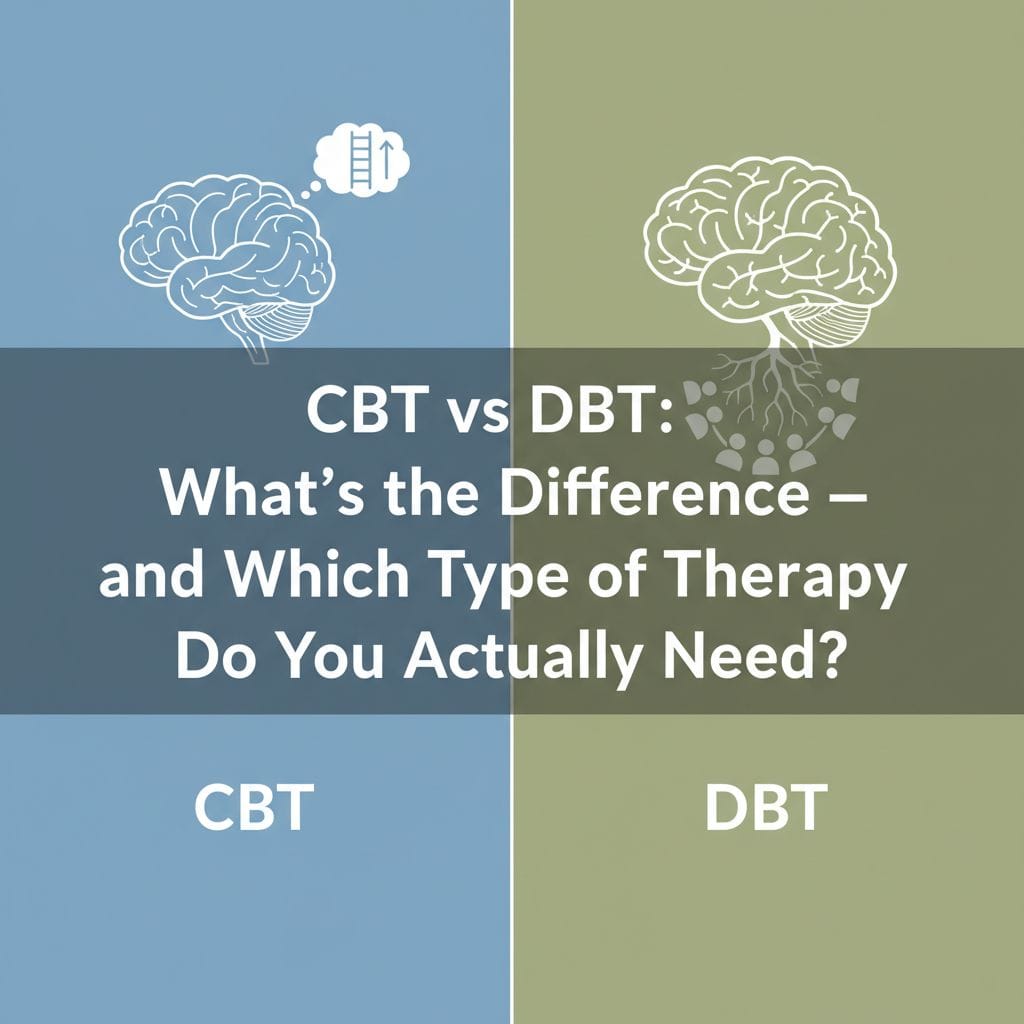
The Quick Answer: CBT vs DBT at a Glance
| 🧠 CBT
Cognitive Behavioral Therapy Change your thoughts |
VS | 🌊 DBT
Dialectical Behavior Therapy Regulate your emotions |
| Developed by Aaron Beck (1960s) | Origin | Developed by Marsha Linehan (1980s) |
| Thoughts drive feelings & behaviour | Core belief | Emotions are valid — and can be regulated |
| 12–20 sessions (typically 3–6 months) | Duration | 12–18 months; longer commitment |
| Individual therapy sessions | Format | Individual + group skills training |
| Anxiety, depression, OCD, phobias, PTSD | Primary uses | BPD, emotional dysregulation, self-harm, eating disorders |
| Thought records, exposure, behavioral activation | Key tools | Mindfulness, distress tolerance, emotion regulation, interpersonal effectiveness |
| Cognitive restructuring | Core mechanism | Dialectical balance: acceptance + change |
| Structured, time-limited, goal-oriented | Structure | Comprehensive, skills-based, longer-term |
| CBT shows greater anxiety symptom reduction (PMC 2023 RCT) | For anxiety | DBT shows greater executive function improvement (PMC 2023) |
| Very strong — first-line treatment (APA) | Evidence base | Strong for BPD; growing for anxiety/depression |
What Is CBT? Cognitive Behavioral Therapy Explained
Cognitive Behavioral Therapy is the most researched psychotherapy in the world and the first-line treatment recommended by the American Psychological Association (APA) for anxiety disorders and depression. It was developed in the 1960s by psychiatrist Aaron Beck, who observed that his depressed patients had a pattern of automatic negative thoughts — and that when those thoughts changed, their mood changed with them.
The Core Insight: Thoughts Drive Feelings
CBT is built on a foundational model: thoughts, feelings, and behaviors are interconnected. Negative automatic thoughts produce painful emotions, which drive avoidant or unhelpful behaviors, which reinforce the original negative thoughts. CBT interrupts this cycle by identifying and challenging the distorted cognitions that drive it.
Common cognitive distortions CBT addresses: catastrophizing (‘this will be a disaster’), black-and-white thinking (‘if it’s not perfect it’s a failure’), mind-reading (‘they think I’m stupid’), fortune-telling (‘I know it will go wrong’), personalization (‘it’s my fault’), and emotional reasoning (‘I feel terrible therefore things are terrible’).
Stress feels different for everyone. What's your type?
Take the free 2-minute Stress Reset Assessment and find out.
Take the Free Stress Test →CBT Key Techniques
| CBT Technique | How it works | Best for |
| Thought Records | Write down the anxious/depressive thought, identify the cognitive distortion, create a balanced alternative response | Catastrophizing, self-criticism, black-and-white thinking |
| Behavioral Activation | Schedule meaningful activities even when motivation is absent. Action precedes mood in depression. | Depression, withdrawal, avoidance |
| Exposure Therapy | Gradual, structured confrontation of feared situations. Builds a hierarchy from least to most feared and works through it systematically. | Phobias, panic disorder, OCD, social anxiety |
| Cognitive Restructuring | Challenging automatic negative thoughts with evidence. ‘What evidence supports this thought? What evidence contradicts it?’ | Anxiety, depression, perfectionism, low self-esteem |
| Behavioral Experiments | Testing anxious predictions against reality. ‘I predicted people would laugh at me. What actually happened?’ | Social anxiety, health anxiety, generalized worry |
What CBT Treats Best
CBT has the strongest evidence base for: Generalized Anxiety Disorder (GAD), panic disorder, social anxiety disorder, specific phobias, depression (major depressive disorder), OCD, health anxiety (hypochondria), and PTSD. A PMC 2023 randomized controlled trial comparing CBT and DBT for GAD found that CBT showed greater reduction in anxiety symptom severity (BAI and GAD-7 scores) than DBT, making it the stronger choice for anxiety as a primary presentation.
How Long Does CBT Take?
Standard CBT for anxiety and depression runs 12–20 sessions, typically weekly, over 3–6 months. It is structured, time-limited, and goal-oriented. Most people know by session 6–8 whether it is working for them. Workbooks (see ResetMindHub’s guide to the best CBT workbooks) can extend the work between sessions and are frequently assigned as homework.
| CBT is the right choice if: your primary struggle is anxiety or depression, and the main driver is thought patterns — worry, catastrophizing, self-criticism, or avoidance. It is the most researched, most widely available, and typically fastest-acting of the two therapies. |
What Is DBT? Dialectical Behavior Therapy Explained
Dialectical Behavior Therapy was developed in the early 1980s by Dr. Marsha Linehan at the University of Washington. Linehan herself had struggled with borderline personality disorder (BPD) — a condition characterized by intense emotional dysregulation, unstable relationships, and chronic suicidal thoughts — and found that standard CBT was insufficient for her patients. She developed DBT as an evolution of CBT with a fundamentally different emphasis.
The Core Insight: Acceptance AND Change
The ‘dialectical’ in DBT refers to the synthesis of two opposing positions: acceptance and change. DBT holds that both are simultaneously true and necessary. You are doing the best you can — AND you need to change. Your feelings are valid — AND you cannot act on them without consequence. This dialectical tension, rather than pure cognitive restructuring, is the engine of DBT.
Where CBT asks ‘is this thought accurate?’, DBT asks ‘can you tolerate this feeling without making it worse?’ The focus shifts from the content of thoughts to the intensity and management of emotions.
The Four DBT Skill Modules
| DBT Module | What it teaches | Helps with |
| Mindfulness | The foundation of DBT. Trains present-moment awareness and the ability to observe thoughts and emotions without being swept away by them. Used in every other DBT module. | Anxiety during daily activities; racing thoughts; dissociation |
| Distress Tolerance | Skills for surviving emotional crises without making things worse. Includes TIPP (Temperature, Intense exercise, Paced breathing, Progressive relaxation), ACCEPTS, and self-soothe. | Panic attacks, acute anxiety crises, urges to self-harm |
| Emotion Regulation | Identifying and labelling emotions, reducing vulnerability to intense emotional states, opposite action (doing the opposite of what the emotion urges). Builds emotional resilience over time. | Anxiety with intense emotional swings, depression, mood instability |
| Interpersonal Effectiveness | DEAR MAN (Describe, Express, Assert, Reinforce, Mindful, Appear confident, Negotiate): scripts for asking for what you need. GIVE and FAST for relationship maintenance. | Social anxiety, people-pleasing, boundary difficulties |
DBT’s Unique Format
Full DBT is significantly more intensive than standard CBT. It includes individual therapy sessions (typically weekly), a DBT skills training group (also weekly, 2–2.5 hours), between-session phone coaching with the therapist, and a therapist consultation team. This comprehensive format is designed for people with complex, high-distress presentations. Skills-based DBT — the skills modules without full DBT intensity — is also offered by many therapists and is appropriate for less complex presentations.
What DBT Treats Best
DBT has the strongest evidence for: Borderline Personality Disorder (BPD), chronic suicidal ideation and self-harm, emotional dysregulation as a primary concern, eating disorders (particularly binge eating and bulimia), PTSD with self-destructive coping, and substance use disorders. It also helps with anxiety and depression when these are accompanied by intense emotional reactions, interpersonal difficulties, or when standard CBT has not been effective.
The PMC 2023 RCT comparing CBT and DBT for GAD found that DBT produced greater improvement in executive function — goal-directed behavior, planning, and psychological flexibility — than CBT. For GAD accompanied by cognitive rigidity, this gives DBT a specific advantage.
| DBT is the right choice if: your primary struggle is emotional intensity — feelings that overwhelm you, relationships that destabilize you, or urges to self-harm. It is also the right choice when CBT hasn’t worked and when your presentation includes more than just thought patterns. |
CBT vs DBT: Which Is Right for You?
Use this decision guide to narrow your choice. These are starting points, not substitutes for a professional assessment — a therapist will always make the most accurate recommendation based on your specific presentation.
| Your situation | Recommended therapy |
| I have anxiety or depression as my primary concern | CBT — first-line evidence-based treatment for both |
| I have panic attacks or phobias | CBT — exposure therapy is the gold standard |
| I struggle with intense, overwhelming emotions I can’t control | DBT — built specifically for emotional dysregulation |
| I have OCD or intrusive thoughts | CBT (ERP) — Exposure and Response Prevention is most effective |
| I engage in self-harm or have chronic suicidal thoughts | DBT — originally developed for this presentation |
| I have been diagnosed with Borderline Personality Disorder (BPD) | DBT — the gold-standard treatment for BPD |
| My anxiety has a strong ‘what if’ or worry thought component | CBT — addresses cognitive distortions directly |
| I have PTSD alongside anxiety or depression | CBT (Trauma-focused) or DBT — discuss with your therapist |
| I’ve tried CBT and it didn’t fully work | DBT or ACT — different mechanism may suit better |
| I have anxiety and also struggle with relationships or impulse control | DBT — covers interpersonal effectiveness alongside anxiety |
| I want the fastest results in the fewest sessions | CBT — typically 12–20 sessions vs 12–18 months for DBT |
| I want the deepest, most comprehensive skill-building | DBT — four full skill modules over an extended program |
| You don’t always have to choose. Many therapists integrate CBT and DBT techniques, and research increasingly supports blended approaches. If you’re unsure, tell your therapist what you’ve read and ask which elements of each apply to your situation. |
Can You Do CBT and DBT Together?
Yes — and this is increasingly common. Because DBT evolved directly from CBT, they share significant common ground: homework assignments, skill-building focus, the importance of the therapeutic relationship, and a present-focused, practical approach. Many skilled therapists draw from both frameworks simultaneously.
A typical integrated approach: CBT tools (thought records, behavioural experiments) to address the cognitive layer, DBT tools (distress tolerance, emotion regulation) to address the emotional intensity layer. This combination is particularly effective when anxiety or depression co-occurs with relationship difficulties, impulsivity, or emotional swings — presentations where neither therapy alone is fully sufficient.
What About ACT? The Third Option
Acceptance and Commitment Therapy (ACT) is a third-wave CBT approach worth knowing about, particularly for people for whom CBT’s thought-challenging feels like another battle with their own mind.
ACT does not try to change or challenge thoughts. Instead, it teaches defusion — changing your relationship with thoughts so they lose their power, regardless of whether you believe them. Combined with values clarification and committed action, ACT is particularly effective for:
- Chronic worry and generalized anxiety (the worry trap)
- Depression with rumination and avoidance
- People for whom CBT thought-restructuring didn’t work or felt artificial
- High-functioning anxiety where the thoughts are hard to challenge because they often come true
ACT is available through BetterHelp, Talkspace, and most CBT-trained therapists. The Happiness Trap by Russ Harris is the most accessible introduction and is available on Amazon. [INSERT Amazon link — tag=smg00ab-20]
Getting CBT or DBT Through Online Therapy
Both CBT and DBT are available through online therapy platforms, making access significantly faster and more convenient than finding an in-person specialist in your area.
For CBT:
- BetterHelp: 30,000+ therapists, most CBT-trained; match within 24–48 hours [INSERT affiliate link]
- Talkspace: in-network with most major insurance plans; CBT-trained therapists available [INSERT affiliate link]
- Online-Therapy.com: specializes specifically in CBT; all therapists CBT-trained
- CBT workbooks: self-guided CBT between sessions; see ResetMindHub’s best CBT workbooks guide
For DBT:
- DBT is harder to access online in its full format (individual + group), but DBT-informed skills coaching is available through most major platforms
- BetterHelp therapists with DBT training can provide skills coaching and the individual therapy component
- For full DBT (including skills group), search Psychology Today’s therapist directory filtered by ‘DBT’ for in-person options in your area
- DBT Skills Workbook by McKay, Wood & Brantley is available on Amazon and provides the four skill modules in self-guided format [INSERT Amazon link — tag=smg00ab-20]
| If you have insurance, Talkspace is in-network with Aetna, Cigna, BCBS, UnitedHealthcare, TRICARE, and more — with copays as low as $0. See ResetMindHub’s guide to online therapy that takes insurance for the full breakdown. |
People Also Ask: CBT vs DBT, Answered
What is the difference between CBT and DBT?
CBT (Cognitive Behavioral Therapy) focuses on identifying and changing negative thought patterns and behaviors. It works on the principle that thoughts drive feelings and behavior, and that changing distorted thoughts produces emotional relief. DBT (Dialectical Behavior Therapy) focuses on managing intense emotions and building distress tolerance. It evolved from CBT but adds four skill modules: mindfulness, distress tolerance, emotion regulation, and interpersonal effectiveness. CBT is typically shorter (12–20 sessions) and more structured. DBT is longer (12–18 months) and more comprehensive, including both individual therapy and group skills training.
Is CBT or DBT better for anxiety?
CBT is the stronger first-line treatment for most anxiety disorders — including GAD, panic disorder, social anxiety, and phobias. A 2023 PMC randomized controlled trial comparing both for GAD found CBT produced greater anxiety symptom reduction (on the BAI and GAD-7 scales). DBT is more appropriate when anxiety is accompanied by emotional dysregulation, self-harm, or when CBT has not worked. DBT showed greater improvements in executive function (planning, psychological flexibility) in the same RCT, which is an advantage when anxiety involves cognitive rigidity.
Is CBT or DBT better for depression?
CBT is the gold-standard first-line treatment for depression, with decades of research and the strongest evidence base. For depression accompanied by intense emotional reactions, relationship difficulties, or self-harm, DBT is more appropriate. A blended approach — CBT’s behavioral activation and cognitive restructuring alongside DBT’s emotion regulation skills — is increasingly used for complex presentations of depression that don’t respond fully to either alone.
What conditions is DBT best for?
DBT was originally developed for borderline personality disorder (BPD) and remains the gold-standard treatment for it. It also has strong evidence for: chronic suicidal ideation and self-harm behaviors, eating disorders (particularly binge eating and bulimia), PTSD with self-destructive coping, emotional dysregulation as a primary presentation, and substance use disorders. It is also used for anxiety and depression when these are accompanied by intense emotions or when CBT has not been effective.
How long does CBT take to work?
Standard CBT for anxiety and depression runs 12–20 sessions over 3–6 months. Most people notice meaningful improvement by sessions 6–8. Research shows that CBT produces lasting changes that persist after treatment ends, particularly when the skills are practiced between sessions. For specific phobias, CBT can produce significant results in as few as 5–10 sessions. For OCD and complex anxiety, longer treatment (20+ sessions) is often needed.
How long does DBT take?
Full standard DBT typically runs 12–18 months, including weekly individual sessions and weekly skills training groups. This makes it a significantly longer commitment than CBT. Skills-based DBT — without the full programme structure — can be completed in 6–12 months. The longer duration reflects the comprehensiveness of the four skill modules and the more complex presentations DBT is designed to treat.
Can you do CBT by yourself?
To a meaningful degree, yes. CBT-based workbooks have clinical evidence for producing improvements in anxiety and depression comparable to some antidepressant medication for mild-to-moderate presentations. NICE in the UK formally recommends CBT bibliotherapy (structured self-help) as a first-line treatment. The best CBT workbooks — including Mind Over Mood and Feeling Good — teach the same techniques used in formal therapy. Results are better when combined with professional guidance, even if only minimal. See ResetMindHub’s guide to the best CBT workbooks. [INSERT Amazon link — tag=smg00ab-20]
What is DBT used for besides BPD?
DBT has expanded significantly beyond its original application for BPD. It is now used for: eating disorders (bulimia, binge eating), PTSD and trauma-related conditions, substance use disorders, depression with emotional dysregulation, anxiety with intense emotional reactions, adolescent behavioral difficulties, and chronic suicidal ideation in various diagnostic presentations. The four skill modules — mindfulness, distress tolerance, emotion regulation, interpersonal effectiveness — are broadly applicable to any condition where emotional intensity is a central feature.
What is ACT and how does it compare to CBT and DBT?
ACT (Acceptance and Commitment Therapy) is a third-wave evolution of CBT that does not try to change thoughts but instead teaches defusion — changing your relationship with thoughts so they lose their power. Rather than asking ‘is this thought accurate?’ (CBT) or ‘can you tolerate this feeling?’ (DBT), ACT asks ‘can you act according to your values even in the presence of this thought?’ ACT is particularly effective for chronic worry, depression with rumination, and people for whom CBT thought-challenging felt artificial or ineffective.
How do I find a CBT or DBT therapist?
For CBT: BetterHelp and Talkspace both offer CBT-trained therapists accessible within 24–48 hours. Talkspace is in-network with most major insurance plans. For DBT: full DBT including skills groups is harder to find online. Search Psychology Today’s therapist finder (psychologytoday.com/us/therapists) filtered by ‘DBT’ for in-person options. For DBT skills-based individual coaching, BetterHelp therapists with DBT training can provide this. If your insurance covers mental health, check whether DBT providers are in-network via your insurer’s provider portal.
Final Thoughts: The Right Therapy Is the One That Matches Your Problem
CBT and DBT are not competing therapies — they are different tools designed for different jobs. CBT restructures the thought patterns that generate anxiety and depression. DBT builds the emotional regulation skills that make those patterns survivable and manageable. For many people, elements of both are relevant.
The most important thing is not to choose perfectly on the first try — it’s to start. The research is clear that both CBT and DBT produce meaningful, lasting improvements for the conditions they treat. Starting with one and adjusting based on your experience is a legitimate and well-supported clinical approach.
If you’re unsure which to choose, tell a therapist what you’ve read in this article. A good therapist will assess your presentation and tell you which framework — or which combination — gives you the best chance of the outcomes you’re looking for.
| You don’t need to diagnose yourself or choose the perfect therapy before you start. You need to start. The therapist will help you refine the approach. Starting is the step. |
🚨 Crisis Support
If you are experiencing thoughts of self-harm or suicide, please contact a licensed mental health professional immediately or call/text 988 (Suicide & Crisis Lifeline) — available 24/7. DBT was specifically developed for people experiencing suicidal ideation — effective, specialized help is available.
Related Reading on ResetMindHub.com:
- Best CBT Workbooks for Anxiety and Depression in 2026
- Best Online Therapy That Takes Insurance in 2026
- Signs of High-Functioning Anxiety: When You Look Fine But Feel Anything But
- What to Expect in Your First Therapy Session
Disclaimer: This article is for informational purposes only and does not constitute a clinical diagnosis or treatment recommendation. CBT and DBT should be administered by licensed mental health professionals. Always consult a qualified therapist or psychiatrist for personalized guidance.